

Get quote
Get Free Consultation!
We are ready to answer right now! free consultation.
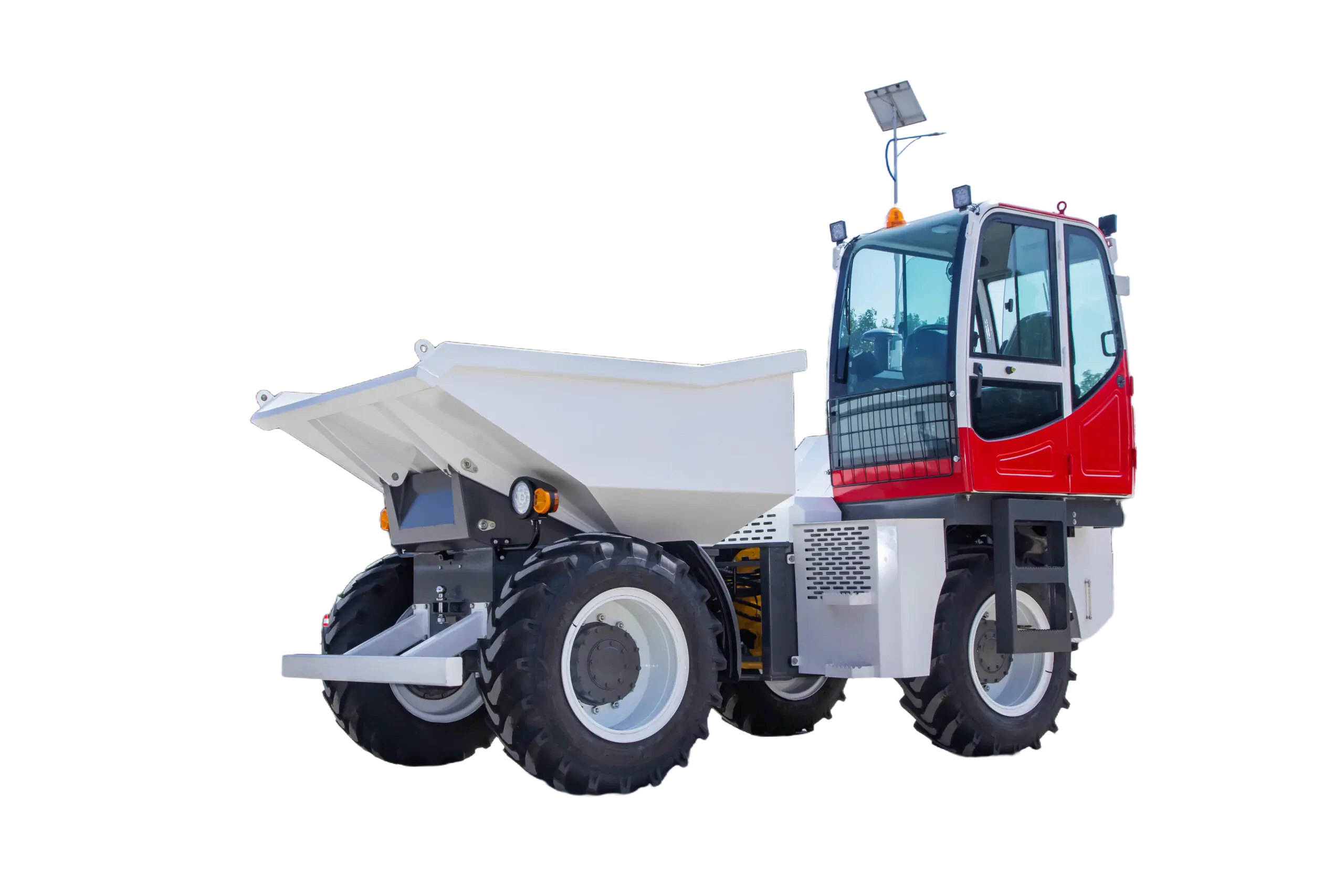
A rotating skip is not the same thing as an articulated chassis. Buyers often ask an articulated site dumper supplier for a compact machine that can steer through confined work and tip to the side, but a quotation may confirm only a plus-or-minus 90-degree skip. If the steering joint is not named, do not assume it exists.
This distinction matters on tight civil sites, landscaping routes and utility projects where turning geometry determines whether the dumper can reach the tip. MEGA’s current dumper pages publish four-wheel drive, widths, turning radii and optional rotating skips across several models. The audited pages do not explicitly state articulated chassis steering for those dumpers. The correct buying action is to request a current chassis drawing and steering specification before using the articulated label.
Begin with the MEGA site dumper family and define which function the project needs: chassis articulation, swivel skip, or both. The first confirmation should be the steering mechanism, because a gallery view or model shape cannot establish it reliably.
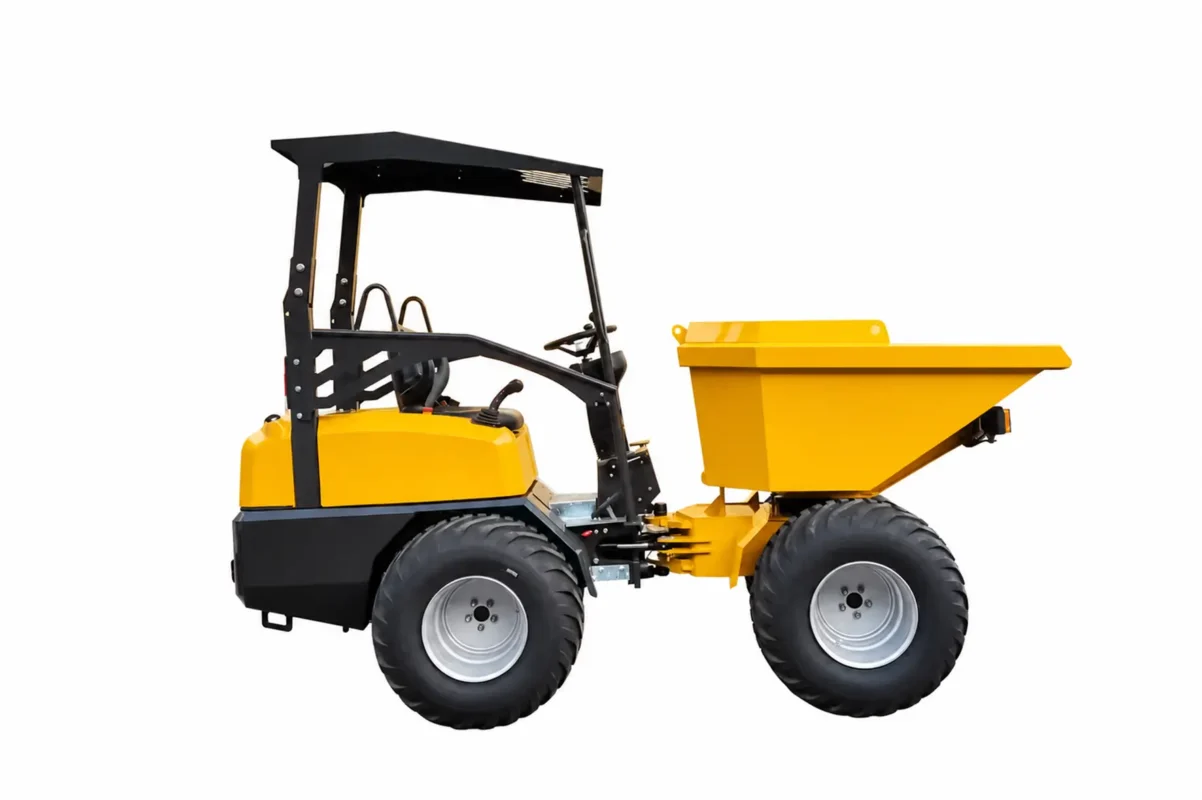
Ask for the steering type, joint location, articulation angle if applicable, turning geometry, oscillation or frame movement where relevant, and how the machine behaves with the skip raised. Request a labeled drawing or current technical sheet tied to the offered model. If the machine uses another steering system, name it accurately.
Also ask for skip mechanism, rotation angle, dumping angle and working envelope. These are separate lines in the order. A machine can have a rotating skip without chassis articulation, or articulated steering with a forward-only skip.
An articulated joint allows front and rear frame sections to change angle. That can affect the path, stability, maintenance points and how operators position the machine. A minimum turning-radius number helps route planning but does not reveal the mechanism by itself.
The MG20D and MG30D pages publish a 4,500 mm minimum turning radius. MG50D, MG60DA and MG100D list 4,850 mm. These values should be confirmed for the current configuration and placed on a route sketch. They do not prove chassis articulation.
The MG10D publishes plus-or-minus 90-degree skip rotation, a 70-degree dumping angle, 480 mm front safe dumping clearance and 398 mm side safe dumping clearance. The page also lists a 2,530 mm maximum dumping height.
Those figures describe the skip and tipping geometry. A buyer can use them to evaluate side discharge, after current confirmation. The rotating mass needs clear space, a stable machine position and an exclusion zone. Do not translate “swivel skip” into “articulated dumper” in sales copy.
The MEGA pages give enough information to form precise questions, but not enough to assert articulated steering across the dumper range. A fact-boundary table keeps the comparison honest.
| Function | Current MEGA evidence | What remains to confirm |
|---|---|---|
| Four-wheel drive | Published on MG20D through MG100D | Exact drivetrain and current supplied components |
| Skip rotation | MG10D states ±90°; several larger models list ±90° as optional | Included mechanism, envelope and controls |
| Turning radius | 4,500 or 4,850 mm on cited models | Measurement condition and completed-unit path |
| Chassis articulation | Not explicitly stated on audited dumper pages | Steering mechanism, joint and angle or alternate system |
| Gradeability | Incomplete field on several larger pages | Model-specific safe limit and conditions |
The MG20D lists an optional plus-or-minus 90-degree tipping bucket, along with 2,000 kg rated load, 1 m³ bucket, four-wheel drive and 1,630 mm width. The MG50D and MG60DA pages use similar optional wording.
If the buyer needs side tipping, the order should state that the rotating mechanism is included. Pre-shipment evidence should show the exact supplied machine performing the function under manufacturer procedures. A product image or general factory video is not an option confirmation.
The MG100D lists a 10,000 kg rated load, 3 m³ bucket, 2,350 mm width and a 4,850 mm minimum turning radius. It publishes four-wheel drive and an optional rotating bucket. None of those statements identifies an articulation joint.
For a large loaded machine, the buyer also needs current braking, steering, tire and tipping information. Request the actual chassis drawing rather than extrapolating from smaller dumpers or from the word “terrain.”
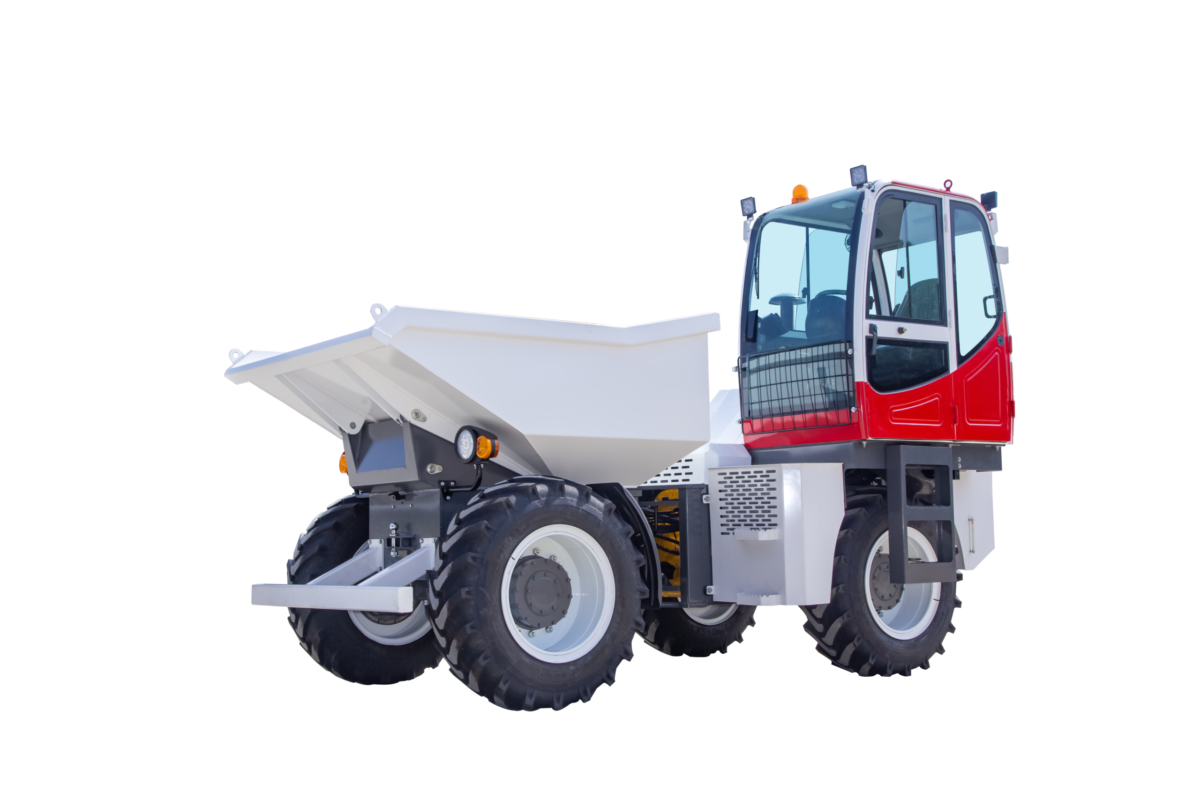
Some buyers use “articulated” when they actually need to discharge sideways without repositioning. A compact swivel-skip dumper may solve that problem even if its chassis is not articulated. Clarify the required movement at the tip.
A utility contractor may haul bedding along a corridor with no room to turn across the trench. The MG10D/MG10DB compact route, with a published 1,046 mm wheel width and rotating skip, can be evaluated for that geometry. Confirm the current safe clearances, route and material load.
The project should prepare a stable tipping point away from trench edges and people. Side discharge reduces repositioning but does not remove edge, visibility or stability controls.
On an open site with a wide receiving area, a forward-tipping model can be sufficient. The rotating mechanism may add cost or maintenance without solving a real constraint. Ask the supplier for a standard and rotating quote only if both routes remain technically suitable.
A buyer earns nothing by specifying articulation or swivel because the terms sound more capable. Each feature should remove a measured route or discharge problem.
If the route includes tight alternating turns, the buyer may specifically need an articulated steering path. Define the centreline path, available swing, surface and passing space. Ask the supplier to plot or demonstrate the offered machine against those dimensions.
A useful drawing identifies wheelbase, widths, joint or steering geometry, maximum steering condition and outer path. If oscillation or frame movement affects stability, obtain the manufacturer’s explanation. The completed-unit measurement should confirm close-clearance projects.
Do not treat the minimum turning radius alone as proof that every corner fits. Wall offsets, skip overhang, tire path and clearance matter. Check both loaded and empty directions.
MEGA’s wheel-loader pages explicitly describe articulated chassis on several models. A wheel loader is not a site dumper, but this contrast shows why product-family language matters. If the buyer needs loading, lifting or bucket work rather than repeated haul-and-tip cycles, the wheel loader range may be the correct comparison.
Do not fit a dumper to a loader job or choose a loader for a dumper route merely because both can carry loose material. The work cycle and rated system decide.
The U.K. Health and Safety Executive’s dumper guidance identifies overturning and collision as major hazards. It discusses gradients, protection, seat belts, even loading, visibility, edge controls, competence and inspection. Local law governs the site, but a supplier evaluation should still address these subjects.
The current larger MEGA dumper pages reviewed here do not display a completed gradeability value. A 4×4 statement or possible articulation does not fill that gap. Request the safe limit and conditions for the exact machine. If the route depends on it and evidence is unavailable, select another route.
Ask what rollover protection, falling-object protection, seat belt, lighting, alarms and visibility equipment are supplied and which destination requirements apply. Do not infer a protective structure from a photograph. Preserve evidence in the order and receiving file.
General HSE tipping guidance notes that articulated vehicles should be tipped with cab and trailer in line. The applicability and correct procedure for a particular MEGA dumper must come from its manufacturer instructions. The buyer’s job is to obtain those instructions and design a stable, clear tipping area.
Dealers often inherit phrases from listings and customer requests. Build an internal vocabulary sheet: four-wheel drive, swivel skip, optional rotation, steering type, articulation and turning radius. Sales staff should use only confirmed terms for each imported configuration.
For MG10D, mark skip rotation confirmed in the current page and chassis articulation not stated. For MG20D, mark 4×4 confirmed and skip rotation optional. For MG60DA and MG100D, do the same until the supplier provides current steering evidence.
“Not stated” prevents accidental misrepresentation. It also becomes the question list for the next supplier call.
Instead of asking only for an “articulated dumper,” state the route need: the machine must negotiate a measured S-turn, stay within a defined outer envelope and discharge ninety degrees to the travel direction. Ask the supplier to identify which requirement is met by steering and which by skip rotation.
Request the model drawing, steering mechanism, maximum steering condition, wheel path, overhang, skip envelope and any stability or operating restrictions. If the supplier proposes a non-articulated model that still fits the route, compare it on evidence. The project needs a movement, not a fashionable term.
For a distributor, preserve the supplier’s response with the stock unit. When staff later advertise or resell it, the product language can remain tied to hardware. This is especially valuable when models change components or when gallery images show optional equipment.
The factory record should show model identity, steering movement, travel, braking, skip lift and rotation where supplied. If articulation is confirmed, show the joint and maximum steering condition according to a safe procedure. The receiver should compare that evidence with the machine.
The final order should name the steering system, articulation joint and angle if present, turning data, 4×4 system, skip type and rotation, safe gradient, protection, dimensions and inspection method. The route plan should use the same terms.
For MEGA’s current site-dumper information, it is appropriate to state that MG10D offers a rotating skip and that several larger models publish 4×4 drive with optional rotating buckets. It is not appropriate to claim articulated chassis steering without additional technical confirmation.
That restraint helps the buyer. If the real need is side tipping, the compact swivel-skip route may be enough. If chassis articulation is essential, the supplier now has a precise evidence request. Either result is better than receiving a machine whose brochure language and steering hardware never meant the same thing.
Keep the final drawing and functional evidence in the receiving packet. On arrival, confirm the steering and skip mechanism before the machine enters the tight route. If hardware differs, stop and resolve the discrepancy; do not ask the operator to discover the real turning envelope beside a trench.
For repeat orders, compare the new drawing and component list very carefully with the first delivered unit already operating in service. A changed steering axle, joint or skip mechanism can affect route assumptions, parts and training even when the model name stays the same. Require the supplier to disclose the change before production.
The confirmed steering hardware should then be tested against the payload, skip and tipping comparison.
