

Get quote
Get Free Consultation!
We are ready to answer right now! free consultation.
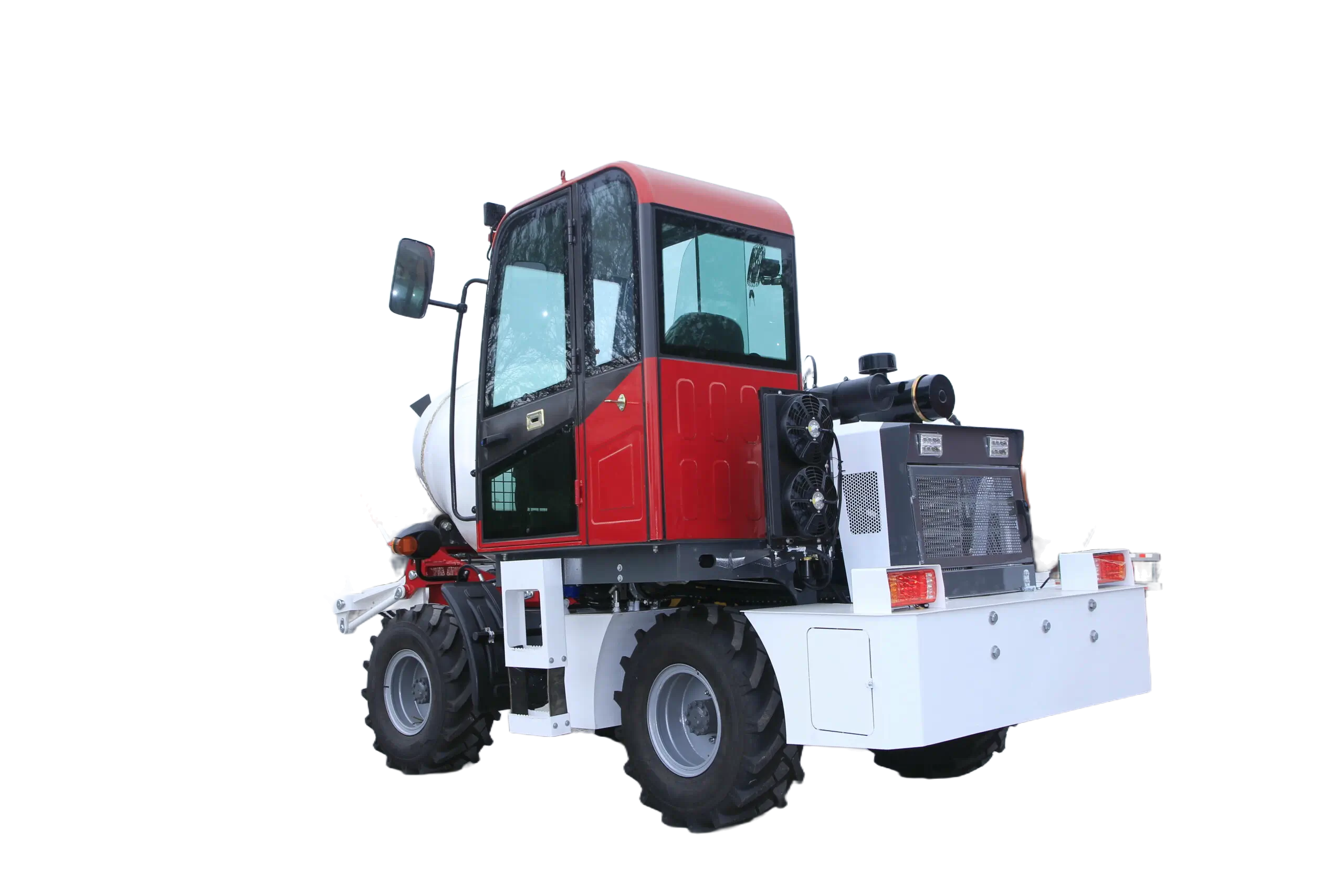
A concrete crew can lose time with a mixer that is too small, but it can also lose time with a machine that produces more concrete than the placement team can receive. The right self loading concrete mixer manufacturer should help a buyer calculate the complete cycle—loading aggregate and cement, adding water, mixing, travelling, discharging and cleaning—before recommending a nominal batch size. That decision matters most to contractors working away from a ready-mix plant, on moving road fronts, small foundations, culverts or dispersed rural sites.
MEGA publishes a broad mixer ladder, from the compact CMT500C with 320 L of concrete per batch to larger machines with mixing capacities of several cubic metres. The first confirmation should be the amount and pace each work front can actually place, not the largest drum the budget allows. Buyers can begin with the self-loading concrete mixer range and eliminate any machine that cannot pass the route or maintain the planned water and material supply.
This selection method does not promise hourly production from catalog capacity. Instead, it produces a testable site plan: required batch volume, expected cycle time, available water, loading layout, travel distance and discharge window. The first shifts then confirm or correct the plan.
Work backward from the placement team. Record the volume of each footing, slab section, drain, curb segment or repair. Note whether one batch can be placed continuously, whether formwork must be changed between batches and how long finishing takes. A batch that waits can create consistency and scheduling problems; a crew that waits for concrete wastes labour and may compromise a planned sequence.
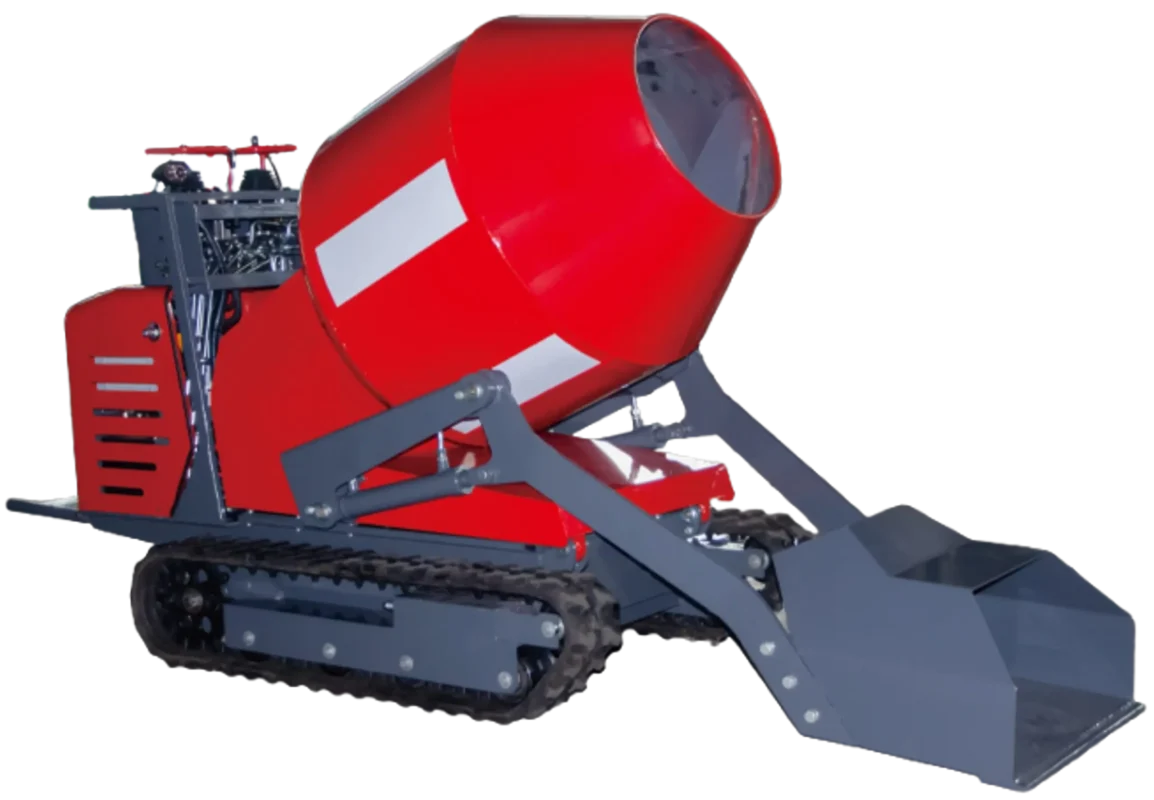
For a culvert crew placing several small elements, the 320 L-per-batch CMT500C may align with controlled, repeated pours. For a larger slab supplied from one aggregate point, a 2.5 or 3.2 m³ route may reduce loading cycles. For a long, open work front, 5.5 m³ may be attractive only if water, materials and placement can sustain it.
Manufacturers and quotations may use several capacity terms. They are not interchangeable. The CMT500C page lists a 500 L total volume and 320 L concrete per batch. The MG1000 page describes a 1.0 m³ model but publishes a 0.7 m³ mixing capacity. The MG1500 is named as a 1.5 m³ model while its page lists 1.0 m³ mixing capacity.
Ask every bidder to put the same capacity definition in the comparison sheet. If one quotation uses geometric drum volume and another uses delivered concrete per batch, a price-per-cubic-metre comparison will be misleading. Require the manufacturer to define the volume, measurement basis and configuration, and preserve that definition in the order.
A realistic cycle contains at least six time blocks: load, water, mix, travel loaded, discharge, and return or reposition. Cleaning and material replenishment interrupt the sequence. Add operator checks and unavoidable waiting. Divide the working period by the conservative cycle, then multiply by confirmed concrete per batch. The result is a planning estimate, not a guarantee.
Suppose a site can place one cubic metre every twenty minutes. A 3.2 m³ batch might not help if formwork accepts concrete in smaller sections. Conversely, a 320 L unit could require so many cycles on an open slab that loading dominates the shift. The manufacturer should challenge both mismatches.
MEGA’s published range lets a buyer compare capacity and machine envelope together. The values below come from current product pages and should be reconfirmed for an order.
| Work rhythm | Model example | Published mixing figure | Site constraint to test first |
|---|---|---|---|
| Small, interrupted pours | CMT500C | 320 L concrete per batch; 500 L total volume | 1,000 mm width, material loading method and 0–6 km/h travel |
| Compact mobile work | MG1000 | 0.7 m³ mixing capacity | 230 L water, 2,220 mm width and 4×4 route |
| General project cycle | MG2500 | 2.5 m³ mixing capacity | 500 L water, 2,350 mm width and placement rate |
| Larger repeated batches | MG3200A | 3.2 m³ mixing capacity | 710 L water, 2,400 mm width and double tires |
| High-volume mobile route | MG5500B | 5.5 m³ mixing capacity | 910/1,070 L water options, 3,000 mm width and receiving pace |
The CMT500C lists an 860 kg machine weight, 15 kW engine, 0.1 m³ loading bucket, 1,000 mm minimum turning radius and 30-degree climbing ability. It is 1,000 mm wide. Those figures suggest a compact access route, but the buyer must still confirm surface, slope, loading arrangement and whether the machine’s 320 L batch fits the mix and placement method.
The MG1000 publishes a 0.7 m³ mixing capacity, 0.3 m³ bucket, 230 L water tank and 4×4 traction. It is 2,220 mm wide and listed at 3,080 mm high with the arm raised. Compared with the CMT500C, it changes both output and access demand. A village gate or indoor work area may decide before batch capacity does.
For either machine, the contractor should identify where cement is opened, how aggregate is presented to the bucket, where water is drawn and where washing is permitted. A compact mixer does not remove those workflow needs; it simply changes their scale.
The MG2500 lists a 2.5 m³ mixing capacity, 500 L water tank, 77.3 kW engine, 4×4 drive and 6,200 kg overall weight. Its published width is 2,350 mm. The MG3200A increases mixing capacity to 3.2 m³, water capacity to 710 L and overall weight to 7,500 kg, with a 2,400 mm width.
The capacity difference is only one part of the choice. The MG3200A page also lists double 16/70 R22.5 tires and a 2.0T wheel-side reduction axle, while the MG2500 lists 20.5/70-16 tires and a 1.8T axle. Buyers should compare ground bearing, access, maintenance familiarity and transport as well as batch size.
Imagine a remote building project where each pour zone accepts about 2 m³ before crews reposition forms and tools. The MG2500 may align more naturally even if a larger machine can enter. On an uninterrupted slab with material and water beside the mixer, the MG3200A may reduce cycles. The right answer comes from the pour sequence.
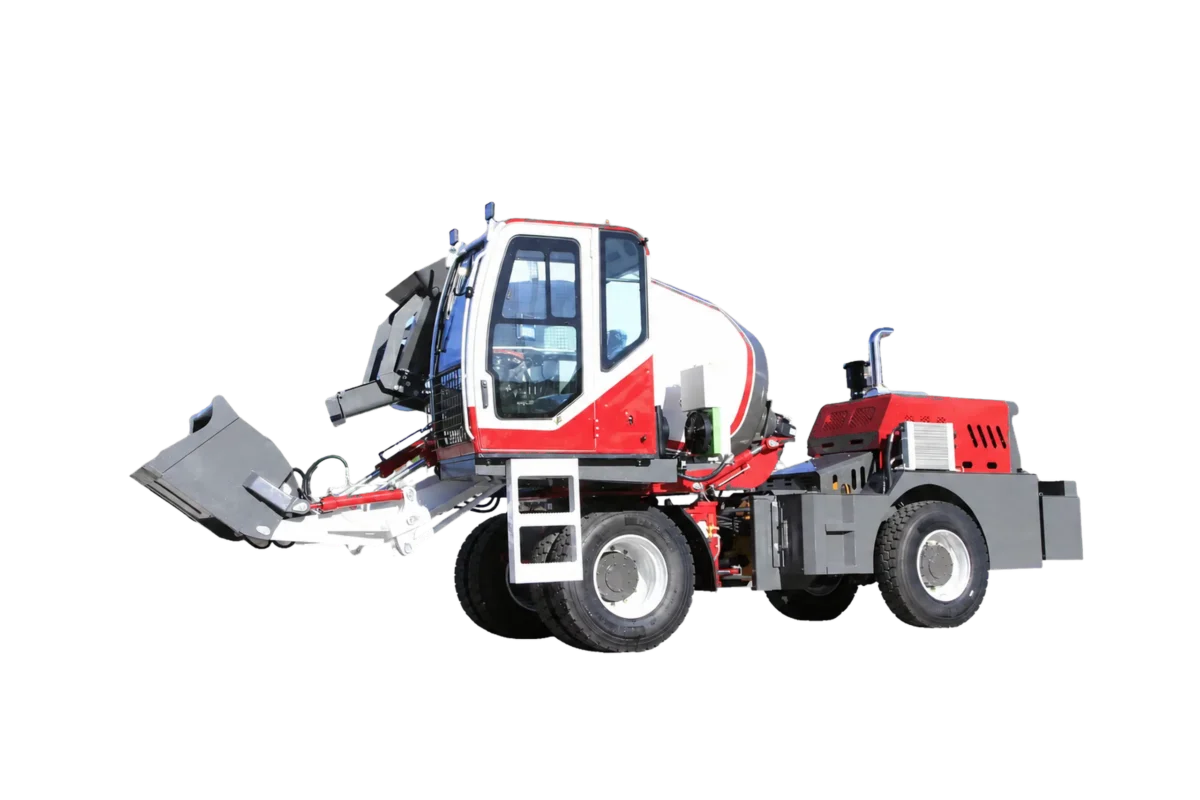
The MG5500B publishes 5.5 m³ mixing capacity, 85 or 91 kW engine routes, 910 or 1,070 L water-tank routes and a 9,000 kg overall weight. It is listed at 3,000 mm wide and 4,220 mm high with the arm raised. Those dimensions may exclude a site before output is considered.
A contractor should calculate the aggregate mass per batch, cement handling, water refill time and placement crew capacity. If the work front pauses frequently, the larger batch can become a queue on wheels. If the site has open access, continuous forms and reliable materials, fewer cycles may justify the larger route.
Water has at least three roles: the mix, equipment cleaning and site control. The product-page water-tank figure does not tell the buyer how much is available for each role or how accurately mix water is measured. Ask the manufacturer to explain the supplied water system, filling method, controls and current configuration.
The AJAX self-loading mixer information provides useful industry context by publishing machine, bucket, water and batch data together. Its figures describe AJAX equipment, not MEGA. The lesson for procurement is to compare complete systems with common definitions and keep competitor specifications out of MEGA’s order file.
A 710 L or 1,070 L tank has little value if the available pump cannot refill it at a workable rate or the machine cannot safely approach the source. Mark water quality, source location, suction or filling arrangement, hose route, refill time and wash-water location. Confirm which fittings travel with the machine and which the buyer supplies.
A road crew moving along a long alignment may need planned refill points. A fixed building site may bring water to one mixing pad. These projects can favour different tank and machine sizes even when their daily concrete volume is similar.
Modern self-loading mixers may be offered with various metering or weighing systems, but a buyer should not assume a function because it is common elsewhere. The cited MEGA pages publish capacities, dimensions, engines, drivetrains and water-tank figures. If the project requires a defined weighing accuracy, water meter, batch record or printout, add it as a requirement and obtain technical confirmation.
This fact boundary protects both sides. The buyer receives the system it planned for, and the supplier is not judged against an unstated feature.
Do not choose a larger mixer when gate width, raised-arm height or turning space is marginal. Do not choose it when the loader cannot be supplied with material fast enough, when the water point creates a long queue, or when the crew places concrete in small interrupted sections. Do not assume a larger machine will handle weak ground better simply because it has more tires or mass.
Also avoid undersizing. Too many small batches can introduce repeated measurement and handling, keep labour waiting and increase travel. If the project needs continuous concrete and the site can support a larger machine, a small unit may become the controlling delay.
The order file should state the first application, target batch, material layout, water source, travel distance, discharge point and expected placement pace. Add the current model specification, selected engine and tires, supplied water components, inspection points, loose items and manuals. If the project changes, revisit the selection rather than pretending the original calculation still applies.
Before dispatch, ask for model-linked evidence of loading-arm movement, drum rotation, water operation, travel, braking and discharge controls. Follow manufacturer procedures; a sales video is not an operator-training program. On arrival, reconcile the model, inspect condition and begin with a controlled batch appropriate to the site.
The best batch size is the one that makes the entire crew more predictable. For a repair team, that may be 320 L. For a general contractor, it may be 2.5 or 3.2 m³. For a continuous open project, 5.5 m³ may earn its place. The manufacturer should be able to explain the fit in minutes and support it with dimensions, water and configuration data—not just point to the largest number in the range.
Keep the calculation after purchase. Record the first week’s average loading, water, mixing, travel, discharge and cleaning times separately. If the crew changes material location or adds a pump, repeat the measurement. These records help the contractor decide whether the next project needs another mixer, a different capacity or simply a better material layout. They also give the manufacturer evidence for a more accurate repeat-order recommendation.
For a distributor, the same records can become anonymized application notes by model: typical access, batch rhythm and support questions, without inventing customer results. That makes future conversations more specific while preserving the distinction between a published specification and an observed local workflow.
Remote buyers can carry the chosen batch route into the supplier dispatch and commissioning guide.
