

Get quote
Get Free Consultation!
We are ready to answer right now! free consultation.
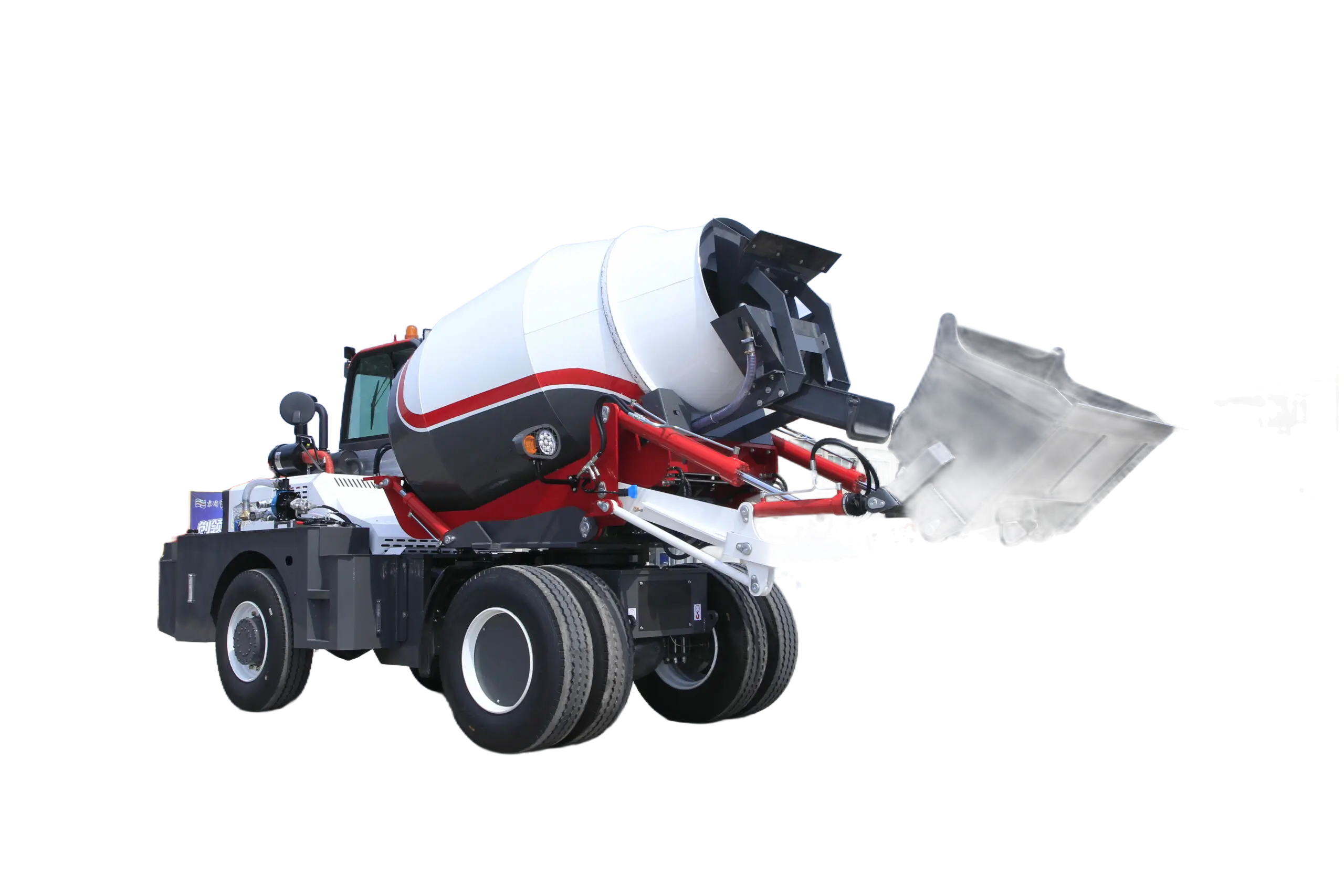
A self-loading mixer can fit the concrete volume and still fail the site. The gate may accept the truck with its loading arm down but not leave room to raise it. An overhead cable may cross the material pad. A tight corner may force repeated reversing around workers. Before approving a self loading concrete mixer truck manufacturer, walk the complete route with a tape measure and record the machine condition at each point.
The survey should cover four zones: entry and travel, aggregate loading, water filling and discharge. Contractors moving between culverts, foundations or road sections need all four. Dealers can use the same survey to screen customers before recommending a stock unit. Start with the MEGA self-loading mixer family, then compare the published raised-arm and lowered-arm dimensions with the actual site.
Capacity comes after the first physical rejection checks. Confirm clear width, overhead clearance, turning and passing areas, ground support, gradient, loaded travel and a safe exit from the discharge point. If the machine cannot complete the route in working form, a larger batch number does not rescue the choice.
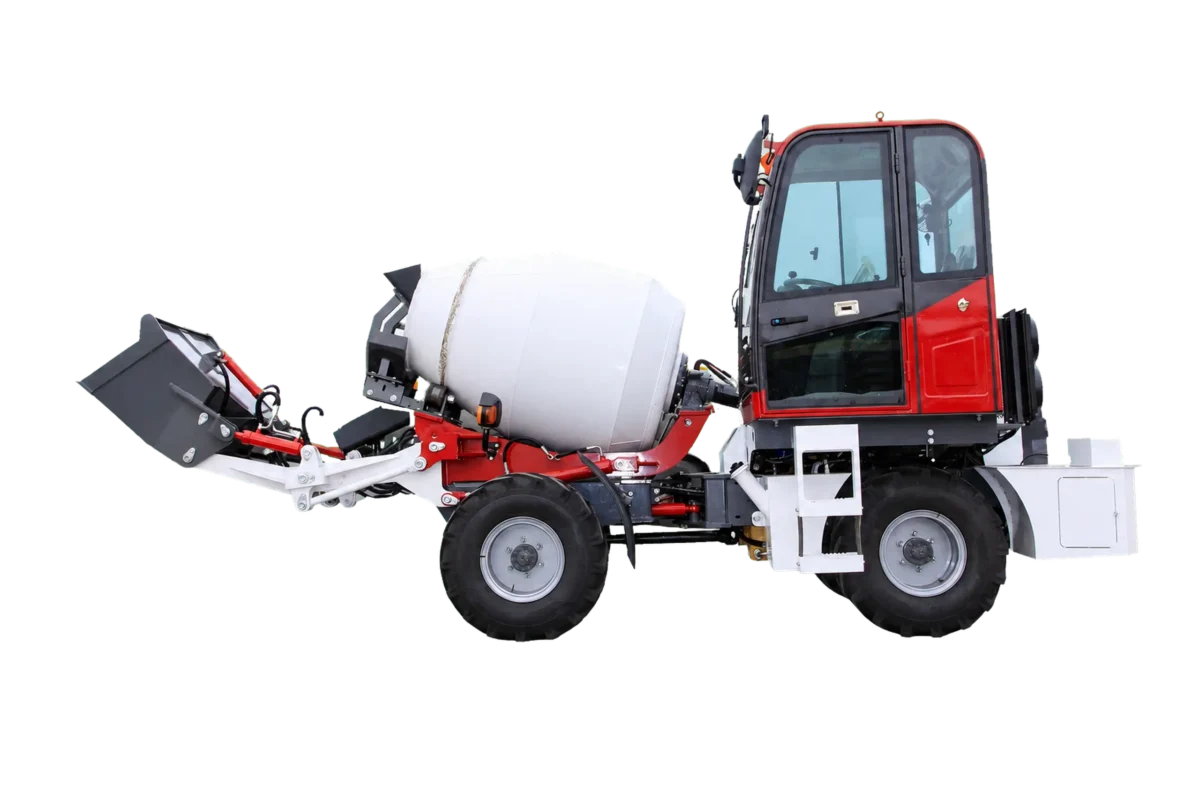
Send the supplier a marked sketch, photographs and measurements. Avoid phrases such as “normal road” or “large gate.” Record the narrowest hard width, soft shoulders, overhead limits, sharpest turn, steepest section, bridge or slab restrictions and places where another vehicle or pedestrian route intersects.
Ask which published dimensions describe the exact quoted configuration. Measure or verify the completed machine before shipment when access is tight. Product development and options can change dimensions, so a page should be the start of the conversation rather than the final access certificate.
Walk the route twice: once in the loaded direction and once in the return direction. A downhill loaded approach may become an uphill empty return with a different turning manoeuvre. Construction materials, parked vehicles and temporary works can reduce clearance after the original survey. Mark measurements with dates and make the site responsible for reporting changes before delivery.
For global buyers, separate machine capability from local traffic rules. Site travel and public-road movement are not the same. Confirm whether the mixer will remain inside a controlled site or must use public roads, and obtain destination-specific advice where required. The manufacturer’s speed figure alone does not establish road legality.
The MG1000 is published at 2,220 mm wide. The MG2500 is listed at 2,350 mm, the MG4000C at 2,800 mm and the MG7500C at 2,920 mm. Add clearance for safe passage, mirrors or protrusions and imperfect gate alignment; do not design to a zero-clearance number.
The aggregate pad may need more lateral space than the entry because the machine turns, positions the bucket and works beside material bays. The discharge point may need room for chutes, people or a connected placement method. Mark the operating envelope, not just tire-to-tire width.
MEGA lists two dimensional conditions on several mixer pages. The MG1000 is 3,080 mm high with the lifting arm and 2,660 mm with the arm down. The MG2500 is listed at 3,610 mm raised and 2,780 mm lowered. The MG4000C rises to 4,220 mm, while the MG7500C reaches 4,640 mm in the published raised-arm condition.
Check cables, roofs, trees, pipes and temporary structures. Overhead hazards require more than a dimension comparison; the project must establish safe controls and comply with local requirements. If the material pad is under a roof, verify both bucket movement and the complete machine envelope.
The same truck behaves differently in each zone. A compact table keeps the survey focused.
| Route zone | Measurements | Machine data | Decision |
|---|---|---|---|
| Entry and travel | Gate, road width, turn, overhead, slope and support | Lowered-arm size, weight, tires and 4×4 | Can the loaded truck enter and leave without unsafe manoeuvres? |
| Aggregate loading | Bay spacing, pile approach, overhead and circulation | Raised-arm size, bucket and steering path | Can it self-load without blocking people or material supply? |
| Water point | Approach, hose, source flow and runoff | Tank volume and supplied filling system | Can each cycle refill without a queue or improvised connection? |
| Discharge | Formwork access, chute or pump, escape path | Discharge arrangement and batch volume | Can the crew accept the batch and release the truck promptly? |
For the MG2500, the page lists a 2.5 m³ mixing capacity, 500 L water tank and 6,200 kg overall weight. Aggregate for each batch is substantial. The pad should keep materials accessible, separated as required by the mix process and supported under repeated machine movement.
If another loader replenishes the bays, give it a separate path. A project can create congestion when the mixer and loader need the same space at the same time. The route sketch should show who yields and where people are excluded during loading.
A tank figure says nothing about refill access. Place the source where the truck can approach in a stable condition, connect safely and leave without a difficult turn. Record hose length, connection, flow and who maintains water quality. Confirm the supplied filling arrangement with the manufacturer.
The AJAX ARGO product information is an example of an industry manufacturer publishing water and machine data together. Its figures apply only to AJAX. Use that structure to prompt questions, while using MEGA’s confirmed specification for the MEGA order.

Once physical fit is established, compare the batch with the placement rhythm. The MG1000 publishes 0.7 m³ mixing capacity. The MG2500 lists 2.5 m³. The MG4000C lists 4.5 m³. The MG7500C lists 7.5 m³. Each step changes machine size, weight, water need and material handling.
A project may accept more cycles because the MG1000 can reach work fronts that a 2.8- or 2.92-metre-wide machine cannot. Its page lists 4×4 traction, a 35 km/h running speed, 230 L water tank and 3,500 kg overall weight. The buyer should confirm turning information, safe slopes and the current configuration.
Frequent cycles have costs: more loading, water control, travel and operator work. Compare those costs with the civil work or traffic changes required for a larger machine. The lowest total disruption may favour the smaller route.
The MG4000C publishes an 8,700 kg overall weight, 85 kW engine, 640 L water tank, 4×4 traction and double 16/70 R22.5 tires. A crew that places only small sections may keep this machine waiting. A continuous foundation or slab with open access may benefit from fewer cycles.
Ask where the truck waits if the work front pauses. Waiting on a narrow access route can block other work. A staging position should support the machine and preserve circulation.
At 12,500 kg overall weight, 7.5 m³ capacity and 2,920 mm width, the MG7500C is a different logistics class from the MG1000. Its published length reaches 8,580 mm with the arm down. A distributor should not present these models as adjacent price steps; they serve different project layouts.
For a large open site, calculate how aggregate and cement reach the loading pad, how 700 L of published water capacity is refilled, and how quickly the receiving crew handles the batch. If any supporting stage is weak, solve it before increasing mixer size.
Buyers often measure how the truck reaches the formwork but not how it leaves. The machine may discharge into a chute, directly at a work front or toward a pump arrangement. Identify the stable position, visibility, people, overhead restrictions and escape path.
Direct placement can reduce equipment interfaces, but the mixer must reach the point without damaging formwork, entering weak edges or trapping itself. Confirm the current discharge arrangement and dimensions. Plan how the crew signals and where people stand.
If the work is below, above or beyond safe approach, use an engineered placement method. Do not extend improvised chutes or hoses without appropriate design and manufacturer guidance.
MEGA’s HBTS30-10-48R trailer pump publishes a 100 mm outlet and pipe diameter, maximum aggregate sizes and theoretical pressure/output figures. If a mixer feeds the pump, the buyer must match concrete, supply rhythm and hopper access. Review the trailer pump range and plan competent pumping operations separately.
The pump can keep the mixer away from a difficult work front, but it does not make the mixer’s entry, loading and water needs disappear. It replaces one discharge constraint with a planned placement system.
The final order file should contain a route drawing and the current supplied dimensions in both lowered and raised conditions. Ask for tape-measure photographs if clearance is close. Include machine weight, wheelbase, tires, steering information, and any removable transport parts.
MEGA states that it performs final debugging, running and load simulation. For this order, ask to see the loading arm move in a clear area, water function, drum rotation, travel, steering, braking and discharge controls under manufacturer procedures. Show the model identity in the evidence.
If a dimension or function differs from the approved route plan, stop and resolve it. Modifying the site after the machine arrives is usually more expensive than correcting the choice before dispatch.
Give the site the final model specification, inspection record, packing list and route plan. On arrival, verify condition and configuration before the truck enters the tightest area. A controlled empty route check can reveal changes caused by site work, parked equipment or weather.
The most useful conversation with a self loading concrete mixer truck manufacturer is not “Which model is most popular?” It is “Show how this exact machine enters, self-loads, fills with water, discharges and leaves our measured site.” When the answer aligns with the MG1000, MG2500, MG4000C or MG7500C data and the placement cycle, the buyer has a route that can be verified rather than a capacity that only looks good in a table.
Keep the route pack with the machine record: annotated plan, critical photographs, confirmed dimensions, working-envelope notes and the receiver’s empty-route check. A distributor can give customers a blank version of the same pack. It makes the pre-sale conversation concrete and gives the next operator a reason for every access limit.
If the route has one marginal point, do not average it away. Treat the narrow gate, weak slab, low cable or blind reversing corner as a rejection gate until an engineered site change or different model resolves it. One short constraint can govern an otherwise open project.
Repeat the route check before every new project rather than treating one successful site as universal proof. A machine that works in an open compound may be wrong for the next bridge approach or enclosed yard. The measured method travels with the fleet even when the answer changes.
Buyers who have cleared the route can use the capacity shortlist by project cycle to narrow the model family.
