

Get quote
Get Free Consultation!
We are ready to answer right now! free consultation.
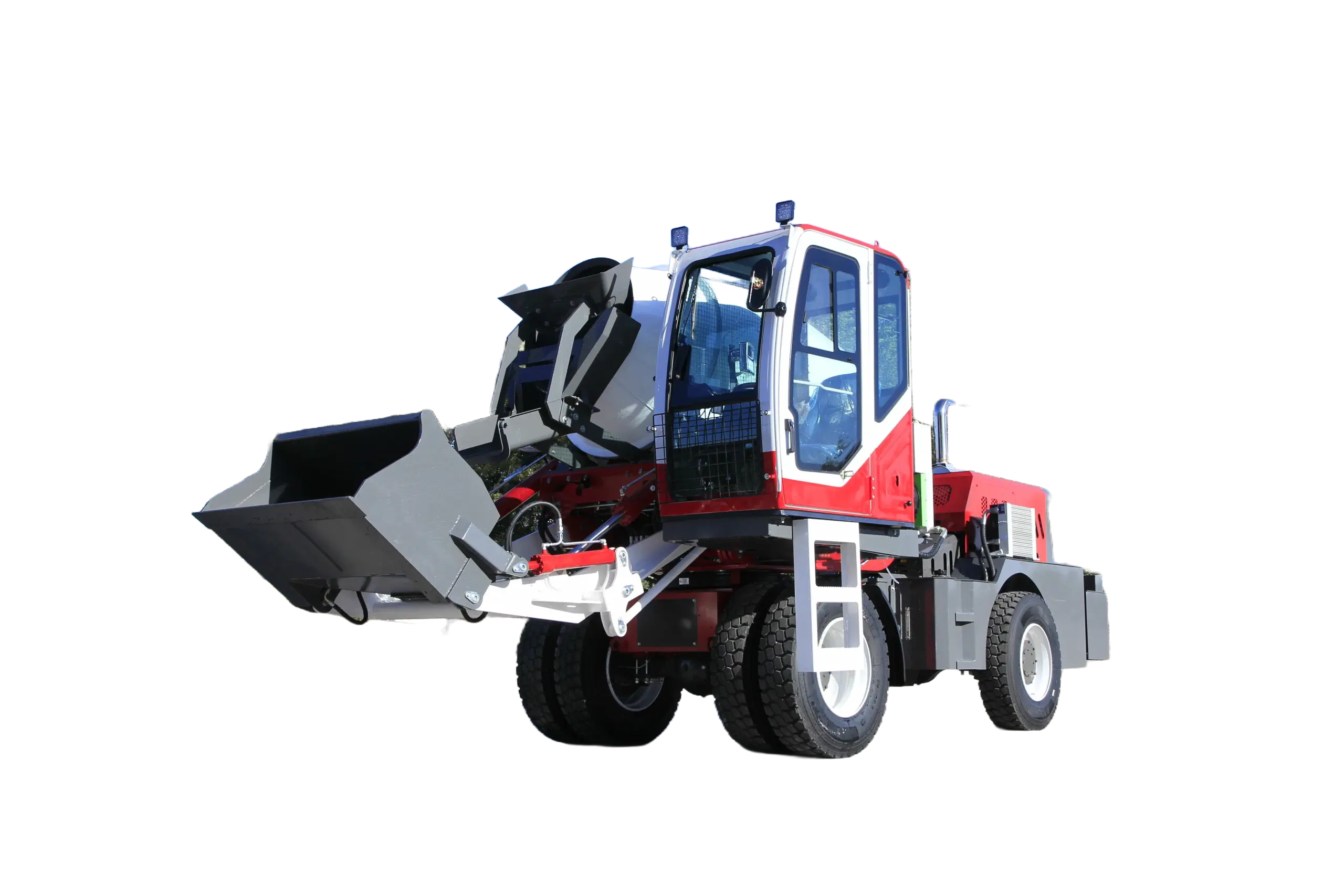
A buyer looking for a self loading concrete mixer for sale is usually closer to a purchase than to a general equipment lesson. The fastest useful shortlist has three routes: compact and interrupted pours, general mobile concrete work, or larger repeated batches on open sites. Choose the route from batch demand, access, water and placement pace; then compare models inside it.
MEGA’s current mixer catalog covers all three routes. The CMT500C publishes 320 L concrete per batch. The MG1500 page lists a 1.0 m³ mixing capacity, the MG3200A 3.2 m³, the MG5500B 5.5 m³ and the MG7500C 7.5 m³. These are not interchangeable upgrades. Machine width, working height, water, weight, tires and the crew’s ability to accept concrete change with capacity.
Before choosing a route, write three numbers: the smallest useful batch, the largest batch the crew can place without waiting, and the daily volume. A project with a high daily total but many small isolated forms can still favour a smaller mixer. A project with one continuous pour may favour fewer large cycles. This simple distinction prevents daily volume from being mistaken for batch demand.
Contractors should first confirm the smallest pour unit and the longest uninterrupted pour. Dealers should identify which three customer groups they actually serve rather than stocking every nearby model. Both can begin in the MEGA self-loading mixer range and reject any option that cannot complete the site route.

Choose the compact route when the work consists of repairs, small foundations, drain elements, landscape structures or narrow access where larger mixers cannot operate. The goal is not minimum purchase price by itself. The machine must reduce manual handling while producing a batch the crew can place without long waits.
The CMT500C lists a 500 L total volume, 320 L concrete per batch, 860 kg machine weight and 1,000 mm width. It uses a 15 kW RATO engine, a 0.1 m³ bucket and travels at 0–6 km/h. The page publishes a 1,000 mm minimum turning radius and 30-degree climbing ability.
A landscaping contractor could use this route for repeated small footings or site elements if the aggregate loading and batch method fit. It is not the efficient choice for a large slab needing continuous cubic metres. Confirm how cement and water are measured and supplied; do not infer controls the order does not name.
The MG1500 lists a 1.0 m³ mixing capacity, 0.35 m³ bucket, 300 L water tank, 55 kW engine and 4×4 traction. It is 2,350 mm wide and 5,500 kg in published overall weight. That is a significant step from the CMT500C in capacity, road space, material demand and transport.
The MG1500 may suit a rural contractor pouring foundations or culverts at dispersed points. It is less appropriate when a 2.35-metre machine cannot pass the gate or when the crew needs only a few hundred litres at a time. Verify whether the one-way or two-way drive dimensional route applies to the quoted unit.
The middle route fits contractors who repeatedly pour several cubic metres but still need to move the production machine between work fronts. A 2.5–3.2 m³ class is often easier to supply and position than the largest machines, while reducing the cycle count compared with compact units.
| Buyer decision | MG2500 route | MG3200A route | What should decide |
|---|---|---|---|
| Mixing capacity | 2.5 m³ | 3.2 m³ | Volume the crew can place per cycle |
| Published width | 2,350 mm | 2,400 mm | Narrowest gate plus safe clearance |
| Water tank | 500 L | 710 L | Mix plan, refill time and cleaning support |
| Overall weight | 6,200 kg | 7,500 kg | Ground, transport and route support |
| Tires | 20.5/70-16 | Double 16/70 R22.5 | Route, support and local service |
The MG3200A publishes a 3.2 m³ mixing capacity, 710 L water tank, 77.3 kW engine, 4×4 drive and 35 km/h running speed. It is listed at 3,900 mm high with the arm raised and 2,940 mm with the arm down.
For a small bridge approach or repeated slab sections, calculate how quickly the loader system fills, how water is supplied and how the crew accepts 3.2 m³. If the placement team stops after two cubic metres, a nominal capacity advantage may become waiting. If a 2.5 m³ machine would require an extra cycle at every work front, the MG3200A may reduce interruptions.
A rental company cannot know every future project, but it can require customers to report gate width, overhead clearance, ground, water, batch need and discharge method. Select a model that covers common work without encouraging use outside its envelope. Provide the current manual and a clear handover; rental familiarity does not remove the need for competent operation.
Keep accessories and parts tied to the model. If the fleet includes MG2500 and MG3200 variants, confirm filter, hose, seal and tire references rather than assuming commonality from appearance.
Rental pricing should also account for site screening and handover time. A larger unit may command a higher rate, but it creates a larger route and support obligation. Record pre-rental photographs, supplied loose items and the approved application. When the machine returns, compare condition at the loading system, drum, water components, tires and discharge area according to the manufacturer’s inspection guidance.

The larger route is for open sites with reliable aggregate, cement, water and placement. It may reduce batch cycles and support longer continuous pours. It also increases machine envelope and the consequence of waiting.
The MG5500B lists a 5.5 m³ mixing capacity, 85/91 kW engine routes, 910/1,070 L water-tank routes, 9,000 kg overall weight and 3,000 mm width. It is published at 4,220 mm high with the loading arm raised.
A contractor should identify where each 5.5 m³ batch goes before approving it. Continuous slabs, foundations or remote batching with open access may fit. Small forms, congested compounds or slow manual placement may not. Confirm which engine and water route the quotation includes.
The MG7500C publishes 7.5 m³ mixing capacity, 12,500 kg overall weight, 2,920 mm width and a raised-arm height of 4,640 mm. It uses a 92 kW engine, 4×4 traction and double 16/70 R22.5 tires. Its length reaches 8,580 mm in the published arm-down condition.
This machine belongs on a route with proven support. A dealer should not offer it merely because a customer asks for maximum capacity. Verify transport, site circulation, water, material stock, ground and placement rate. If one of those fails, move down a class or use a different concrete-supply method.
A self loading concrete mixer for sale should have an itemized offer: exact model and configuration, included bucket and water components, manuals, recommended commissioning items, spare parts, packing, inspection scope and shipping basis. “Standard configuration” is not enough when pages list alternatives.
The MG1500 page lists a YN26GBZ engine and 1.8T wheel-side reduction axle. The MG3200A lists a YCD4M22T-105 engine, 2.0T axle and double tires. The MG5500B lists two engine-power routes and a 2.5T axle. Record the installed components because they affect parts planning and can explain price differences.
Do not automatically select the heavier component. Ask why it fits the route, whether local service can support it and which documents accompany it.
Self-loading mixers from different manufacturers may offer various weighing and water-control systems. AJAX’s self-loading mixer information illustrates the types of machine and water data an industry supplier may publish. Its equipment and figures are not MEGA specifications.
For the selected MEGA model, ask what filling, metering or weighing equipment is included. If the project needs a defined batch record or accuracy, put that requirement in the order and obtain technical confirmation.
Reject the compact route when repeated cycles cannot meet placement demand. Reject the general route when site access or batch rhythm still points to a smaller machine. Reject the high-capacity route when material supply, water, ground or placement cannot sustain it. Reject any quotation that cannot define capacity or identify the offered configuration.
Buying for every possible future project often creates a machine that is inconvenient on the current one. Select for the first committed work and keep a documented expansion path. A contractor can add capacity later; it cannot easily shrink a machine that does not fit the gate.
For compact units: What is the smallest and largest pour, and what is the narrowest access? For general units: Can water and placement sustain 2.5–3.2 m³ cycles? For large units: Is the site open, supplied and ready to receive 5.5–7.5 m³ batches? These questions make a stock conversation useful before price.
The final file should contain the exact model, defined capacity, working and travel dimensions, installed engine, axle and tires, water configuration, supplied controls, loose items, inspection evidence and a first-batch description. Ask the supplier to show the model identity during functional checks.
On arrival, inspect condition and reconcile the configuration before commissioning under the manufacturer’s instructions. Measure the first complete cycle and record waiting. The number reveals whether the project needs a site improvement, a different batch plan or a different machine next time.
The practical shortlist is now small. CMT500C or MG1500 for compact and interrupted work; MG2500 or MG3200A for general project cycles; MG5500B or MG7500C only when open access and strong supply make large batches productive. That is a purchase decision a contractor or dealer can defend after the product photo is forgotten.
Ask for one alternative model beside the recommended choice and require the supplier to explain what site fact would cause the buyer to switch. For example, a narrower gate may move the decision down a class, while an uninterrupted placement rhythm may justify moving up. This conditional recommendation is more useful than a “popular model” label.
Finally, compare the self-loading route with the nearest genuine alternative. Reliable ready-mix delivery may be better on an urban site; a fixed batching solution may suit continuous central production; a compact mixer may be the only practical choice on dispersed works. Buying is justified when mobility, self-loading and the selected batch solve a real supply problem.
That final alternative check also protects resale value for future projects. A well-matched machine accumulates understandable application history, service records and parts identity. A machine bought only for a headline capacity is harder for the next owner to evaluate when the original site never used its envelope.
Once capacity is fixed, compare the Chinese mixer quotation factors without reopening the job definition.
