

Get quote
Get Free Consultation!
We are ready to answer right now! free consultation.
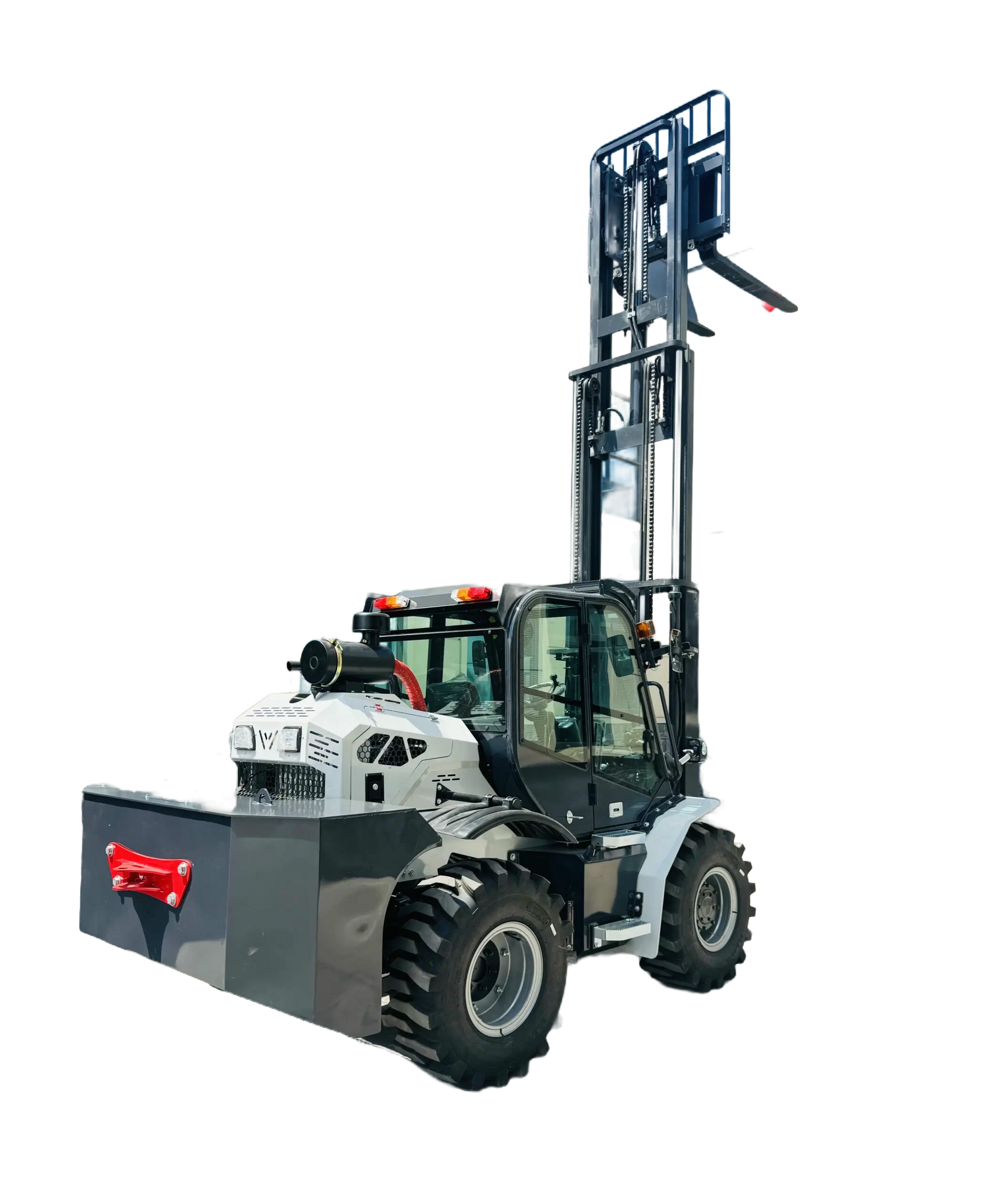
A timber yard asks for four-wheel drive because the route climbs from an outdoor stack to a warehouse. That answers only whether the forklift can develop traction. It does not answer whether a long pack remains stable on the grade, whether the mast clears the door or whether the forklift has approved capacity at the actual load centre. A 4×4 forklift manufacturer in China should evaluate the complete route.
MEGA lists MG3501, MG3550, MG3580, MG3581 and MG3582 in its all-terrain forklift range. Each is presented in the 3,500 kg class with outdoor drive features. The pages also show why the buyer needs a route drawing: mast height is fixed only after selection, tires differ, machine weights span published values from 4,500 to 5,300 kg, and some turning-radius entries require confirmation.
Walk the route empty before choosing a model. Mark the pallet, pickup direction, lower and upper grades, cross slope, turn, drainage channel, soft shoulder, warehouse door, placement height and pedestrian conflict. Then send the drawing and load geometry to the manufacturer for an approved configuration.
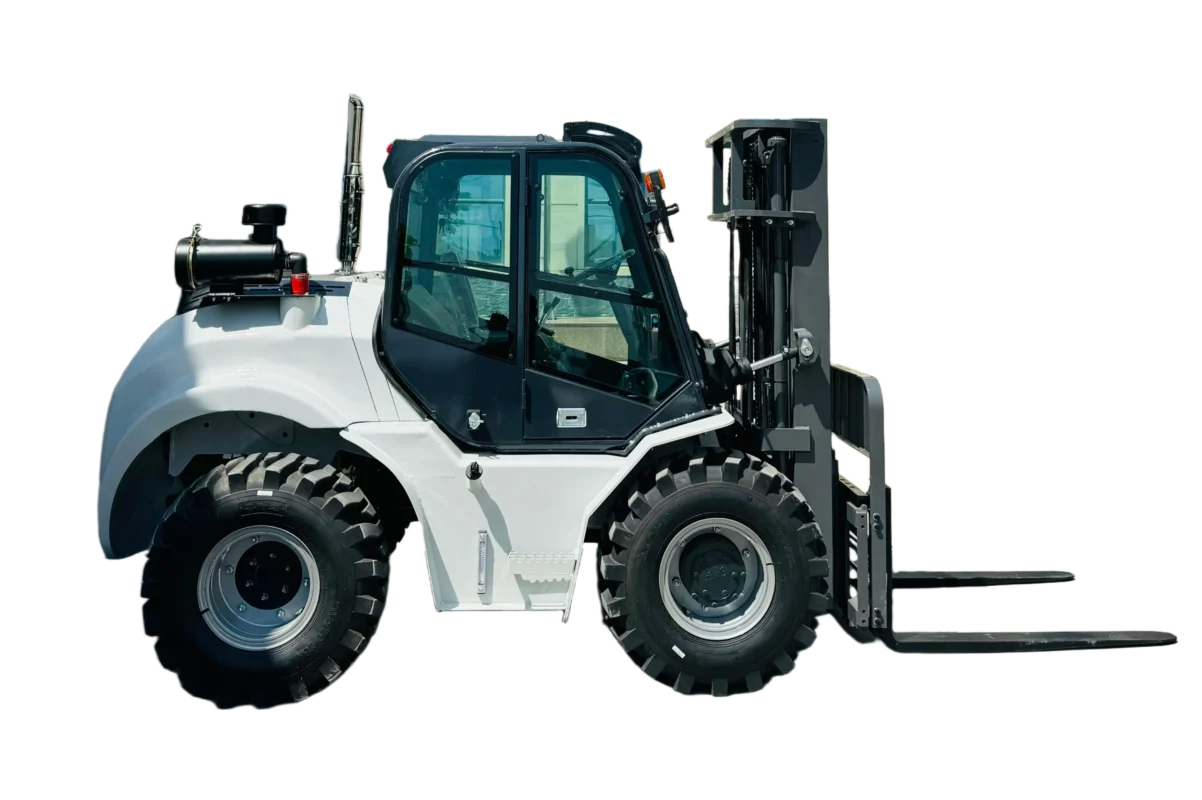
Traction describes the ability to transmit drive force to the ground. Stability depends on machine geometry, load centre, mast position, surface, speed, steering and slope. More driven wheels do not permit travel with a raised load or a sharp turn across a grade.
The timber pack’s mass and centre of gravity should be verified. State whether the forklift will travel up or down the grade loaded and which direction the load faces. Follow the manufacturer’s instructions for grade travel; do not invent a rule from the drive type.
MG3501 publishes maximum gradeability of no more than 25 degrees. This is not a promise that a 3,500 kg long load can work routinely on such a grade. Ask for approved loaded limitations for the selected mast, tires and load centre. The site should aim to reduce the route slope and keep the travel surface firm.
If the yard currently turns across the hill, redesign the lane or create a level turning pad. Keep the load in the manufacturer-approved low travel position. Restrict speed and separate people. A machine that can climb straight may still be unsuitable for a turn with a long pack.
After rain, stop and reassess ruts, mud and edge strength. Four-wheel drive may help the forklift enter an area that is no longer safe for loaded handling. Supervisors need a clear closure rule.
The outdoor lift requirement may call for a tall mast while the indoor route has a low doorway. Measure the highest placement, minimum door height and any overhead obstruction. The selected mast’s collapsed height, overhead guard and raised load all need separate checks.
The MG3501 lists lifting height from 3,000 to 6,000 mm and gantry height from 2,250 to 2,930 mm. It also lists a 500 mm load centre, 3,400 x 1,800 x 2,250 mm overall dimensions and 1.22 m-class optional handling routes through its attachments section.
The buyer should select one mast and request a drawing showing collapsed, free-lift and maximum fork height as applicable. Ask for approved capacity at the timber pack’s real load centre and placement height. Do not pair the lowest gantry figure with the highest lift unless the manufacturer confirms that exact combination.
The MG3580 and MG3582 pages use custom multi-stage mast wording. MG3580 lists 2,250 mm overall height, while MG3582 lists 2,500 mm. Those values may determine warehouse entry, but the offered mast and any overhead structure need confirmation.
If the forklift crosses from outdoor rough ground into a building, mark a level transition before the door. Do not raise the load to see past the mast or correct an approach. Provide a clear line of travel and follow approved visibility procedures.
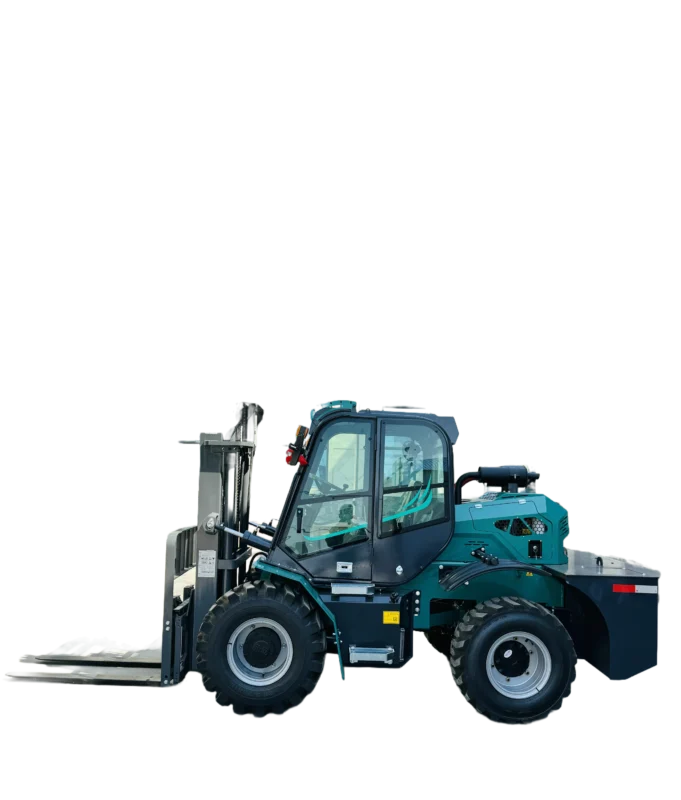
Tires and clearance matter when the forklift crosses stones, ruts or transitions, but they do not replace road maintenance. The best rough-terrain route is still prepared, drained and inspected.
MG3501 lists 23.5/70-16 tires, 300 mm wheelbase ground clearance and 240 mm gantry clearance. MG3581 lists 20.5/70-16 front and rear tires and 230 mm minimum clearance. Confirm the delivered tire marking and any effect on overall height, load information and spare support.
A dealer should stock service items for the selected tire and brake route. The user should inspect condition and follow the manufacturer’s pressure or maintenance specification. Swapping to an unapproved tire can change geometry and handling.
If a channel or threshold creates a sudden wheel drop, repair it or install an appropriately designed crossing. Do not use ground clearance as a target obstacle height. A long load can pitch or shift when one axle changes level.
The site drawing should show edge strength near trenches, retaining walls or loading docks. Keep the forklift at a competent-person-defined distance and establish barriers where required.
A timber pack may be 1,800 mm deep in the fork direction, placing its centre near 900 mm if uniformly distributed and fully against the fork face. That is very different from MG3501’s published 500 mm reference. Irregular density or incomplete fork insertion can move the centre farther.
Provide mass, dimensions, centre of gravity, banding and fork-entry direction. Ask for capacity at the selected mast height and centre. If it is below the pack mass, divide the load, change packaging, use an approved attachment or choose other equipment.
General OSHA load-composition material explains why load weight, position and stability matter. The manufacturer must supply the machine-specific capacity answer, and local requirements govern operation.
If a timber clamp is requested, identify its mass, centre, opening range and hydraulics. The clamp may improve load control but reduce residual capacity. Its outer swing should be added to the warehouse door and turning drawing.
The order and data plate treatment should reflect the approved attachment. A dealer cannot treat a clamp as removable showroom decoration while keeping the same capacity claim.
MG3501 lists a 2,200 mm minimum turning radius. MG3580, MG3581 and MG3582 list 500 mm, a value that appears unusually small relative to their dimensions. The buyer should not design a warehouse aisle from that number without confirmation.
On a level open pad, mark the tire, counterweight and outer load paths at the approved steering limit. Record speed and configuration. A long timber pack may determine the required aisle even if the rear of the forklift turns tightly.
If the supplier corrects the page value or drawing, use the corrected controlled document. Preserve the change in the purchase file. An honest correction is more useful than an attractive figure left untested.
Soft ground can immobilise a forklift even when the original route was prepared. The site needs an approved response before this happens. Ask for towing, lifting and recovery points, machine weight, parking-brake release information and prohibitions in the delivered manual.
MG3501 and MG3582 both publish 4,500 kg machine weight, while MG3580 lists 5,300 kg and MG3581 5,000 kg varying by configuration. Recovery equipment and ground must suit the actual delivered weight plus load or attachments. Never attach a chain to the mast, axle or guard because it appears strong.
Unload or secure the pallet only through an approved procedure. A stuck loaded forklift may be less stable than it appears, especially on a slope or soft shoulder. Establish an exclusion zone and use competent recovery personnel.
Record the location and ground condition after any immobilisation. Repair drainage, add suitable engineered support or reroute traffic. If the forklift repeatedly needs towing, the 4×4 selection has not made the path operationally acceptable.
Factory acceptance should verify configuration: model and engine identity, mast, forks or clamp, tires, drive mode, brakes, steering, lights, warnings and capacity information. Use a known approved load on a level safe area for lift evidence. Do not request a maximum-grade stunt.
At the destination, inspect and prepare the route. Travel it unloaded under the manufacturer’s procedure, checking clearance and steering. Introduce a verified approved load only through a documented commissioning plan. Stop if ground deforms, the load shifts or visibility is inadequate.
Measure the delivered collapsed mast and overall height. Confirm door clearance with the approved travel position and load. Protect pedestrians and building edges. If the mast does not match the drawing, resolve the deviation before entry.
Mark the level turn and set-down points. Inspect surface after weather or civil work. Keep new pallet types out of the route until mass and centre are reviewed. Daily machine checks should follow the delivered manual and include tires, forks, attachment, mast, hydraulics, steering and brakes.
The correct 4×4 forklift for this yard is not the one that climbs the steepest empty. It is the MG3501, MG3580, MG3581 or MG3582 configuration that carries the verified pack within approved capacity, maintains stability on a prepared path, clears the door and can be supported by the dealer. Traction makes the route possible only after those conditions are satisfied.
Keep the approved route drawing beside the machine’s capacity and mast file. A new warehouse rack, longer timber pack or resurfaced slope can change three assumptions at once. Review those changes before operation, not after an operator discovers the new limit with a raised load.
Transport planning should also use the selected mast and actual machine weight. A custom tall mast may alter shipping height, while an attachment can require separate securing and lifting. Ask for packed dimensions, removed items, lashing guidance and the weight of every loose component. The receiving yard should prepare a level unloading and assembly area instead of opening the container beside the working slope.
At arrival, photograph tire condition, mast, forks or clamp, labels, hoses and transit restraints before moving the forklift. Compare collapsed mast height with the door drawing and machine identity with the approved file. Commission steering and brakes on the level pad before testing the prepared outdoor path.
For the first two weeks, inspect the slope daily and record loads that approach the agreed boundary. Note rain, surface damage, wheel slip and any need to change route. If operators regularly need extra momentum to climb, stop and reassess the surface, load or machine; speed should not become the substitute for traction planning.
The maintenance handover should identify tire route, drive components, filters, brakes and mast service points for the delivered model. MG3501, MG3580, MG3581 and MG3582 should not share parts assumptions merely because each carries a 3.5-ton description.
Projects that need one machine for digging and loading can compare the route with the backhoe-loader utility sequence.
