

Get quote
Get Free Consultation!
We are ready to answer right now! free consultation.
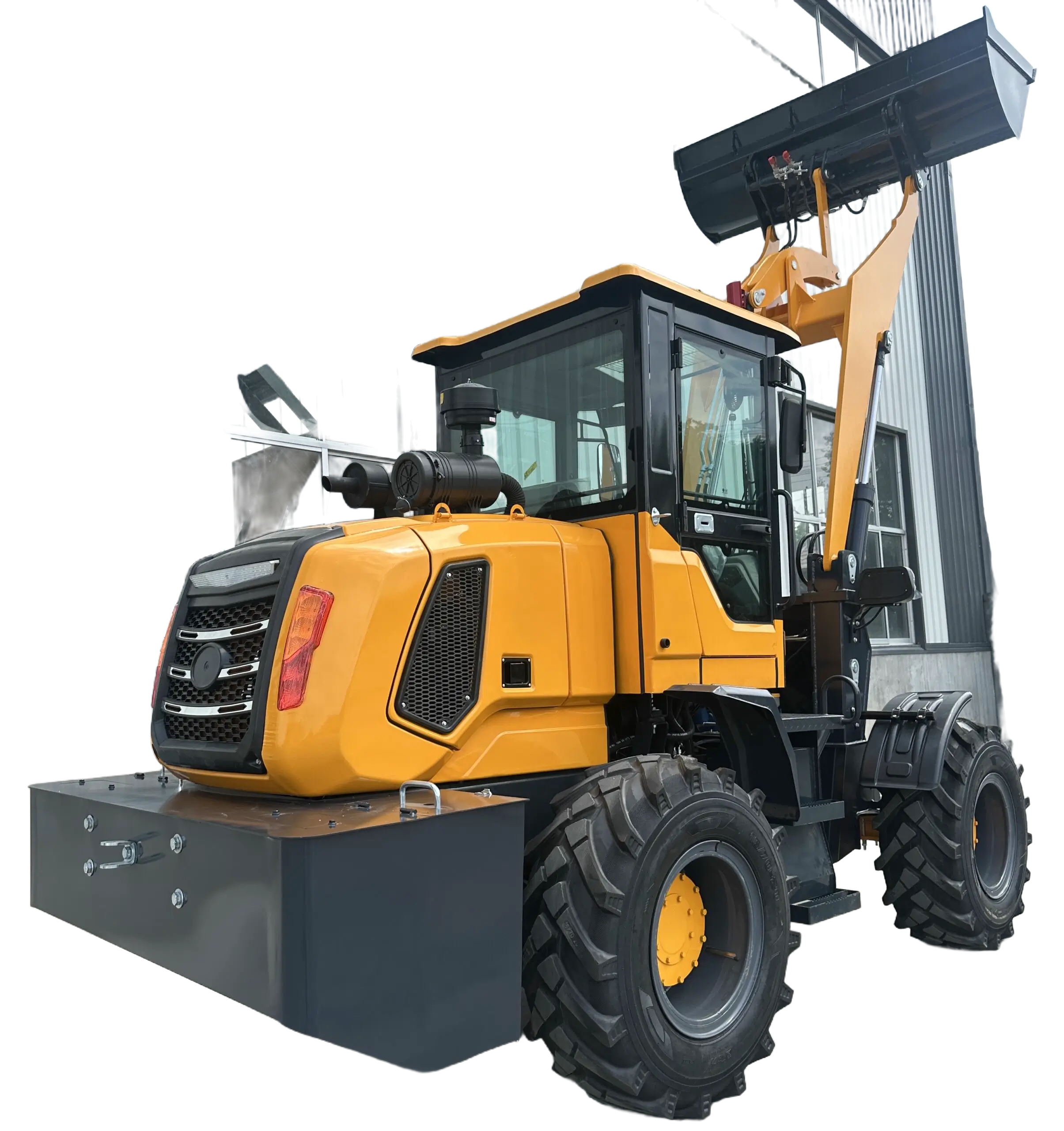
A dealer does not need five loaders that all compete for the same customer. It needs a range with visible steps: a compact machine for restricted access, a general-purpose unit for daily yard work, a 2-ton class for heavier material, and a higher-capacity route for truck loading. When assessing a wheel loader supplier in China, define those sales roles before selecting models or attachments.
MEGA’s published range runs from the 800 kg MG910C to the 3,000 kg MG940, with the 1-ton MG910, 2-ton MG936 and 2.5-ton MG958 between them. A dealer can begin at the wheel loader range, but stocking decisions should also include the local gate width, common truck-side height, material density, service capability and buyer budget. A payload ladder alone can create expensive overlap.
A rural dealer may need one small machine that enters farms and workshops without presenting it as a quarry loader. A rental business may need its 2-ton and 3-ton units to share operating conventions while remaining clearly separated by payload and bucket duty. Both buyers should freeze the exact engine, transmission, tire and bucket before the first inbound shipment.
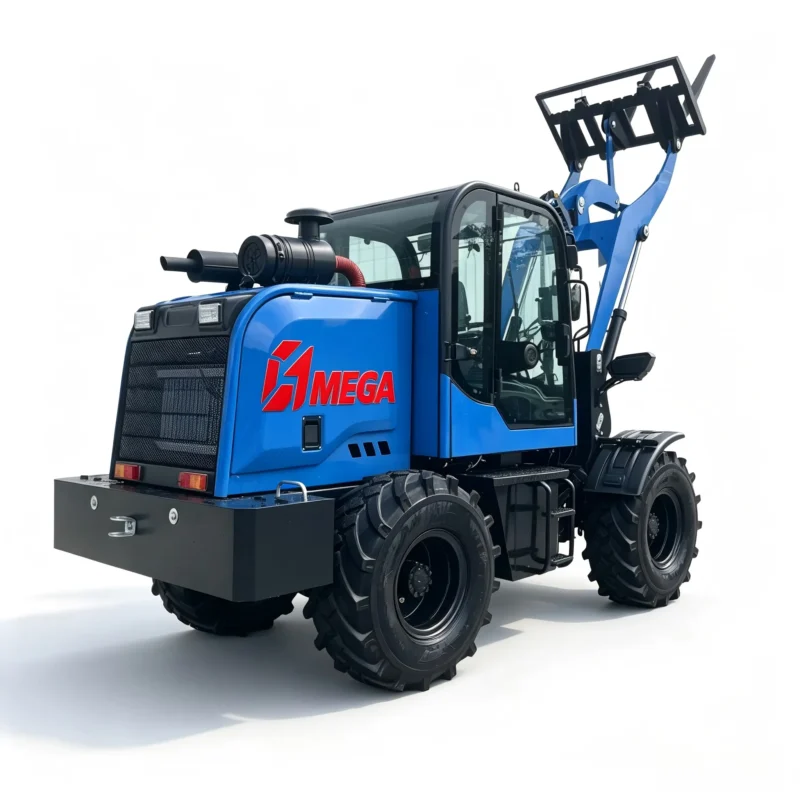
The first tier should solve access. The middle tier should handle the largest volume of ordinary customers. The upper tier should cover work that would routinely overload the middle machine. Each stocked unit needs a sentence explaining who should buy it and another explaining who should not.
The MG910C lists an 800 kg rated load, 1,500 kg operating weight, 0.3-0.5 m³ bucket range and 1,300 mm overall width. Its height is 1,980 mm, dumping height 2,400 mm and ground clearance 250 mm. A 20 kW engine, manual 2F/2R gearbox and 4×4 drive complete the published configuration.
That combination can suit farms, landscaping work, small yards and customers who first ask whether a loader will pass a gate or roof. It is not a substitute for a 2-ton machine when wet aggregate or continuous truck loading defines the job. Sales staff should calculate the likely bucket mass from the customer’s material instead of selling the largest volume in the published range.
For the showroom, record the installed bucket width and tire specification beside the machine. If a customer needs a different bucket, the supplier should confirm changed dimensions and capacity. Compact buyers are often the least tolerant of an undocumented width change.
The MG910 publishes a 1,000 kg rated load, 0.4 m³ bucket, 1,400 mm bucket width, 2,300 mm dumping height and 750 mm reach. It has a 45 kW engine, articulated chassis, 4×4 drive and 2,100 kg operating weight. Its overall dimensions are 3,300 x 1,500 x 2,350 mm.
This model can serve buyers who need more rated load than MG910C and can accept a taller, wider machine. It also gives a dealer a simple explanation: MG910C is primarily the restricted-access entry; MG910 is the 1-ton articulated work route. A customer with a 2.1 m roof may still fit MG910C on published height while MG910 would not. That boundary protects the sale from becoming a specification argument after delivery.
The MG936 lists a 2,000 kg rated load, 1.2 m³ bucket, 2,000 mm bucket width, 3,500 mm dumping height and 1,000 mm reach. It also lists a 78 kW engine, automatic 4F/4R transmission, 4×4 articulated steering and 5,300 kg operating weight.
For a dealer serving building contractors, aggregate yards and general material handling, this can be the middle production tier. The supplier page also offers several engine directions and notes that parameters may change. The dealer therefore needs a signed configuration schedule, not just a model name. Parts stock and technician training depend on the engine, axle, transmission, brake system and hydraulic controls actually delivered.
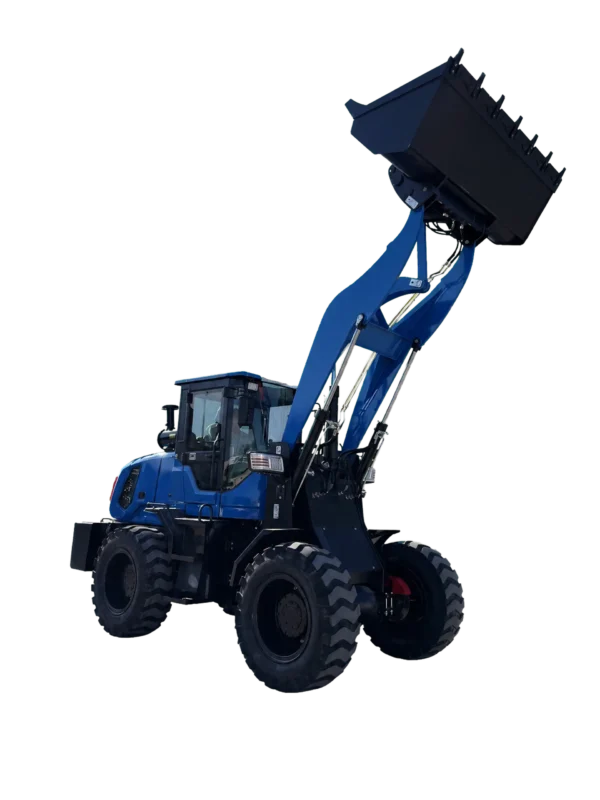
The upper showroom tier often attracts the same buyer, so MG958 and MG940 need a clear distinction. The MG958 publishes a 2,500 kg load, 1.5 m³ bucket and a 3,500-4,500 mm dumping-height range. MG940 publishes a 3,000 kg load, 1.2 m³ bucket and 3,500 mm dumping height. The heavier-rated machine does not automatically have the larger bucket.
MG958 may suit a buyer who values its listed 1.5 m³ bucket or needs to explore the upper dumping-height configuration. Its 92 kW engine, 5,500 kg operating weight, automatic 4F/4R route and 2,000 mm overall width should be matched to the site. The dealer must identify which ordered configuration produces the quoted height; a range is not enough for a customer with a fixed truck side or hopper lip.
This unit should not be sold merely because the customer asks for “something bigger.” Ask for material density, normal bucket fill and receiver dimensions. A light-material customer can use volume differently from a buyer moving wet sand.
The MG940 lists a 3,000 kg rated load, 1.2 m³ bucket, 78 kW engine, 4,500 kg operating weight and 6,150 x 2,050 x 2,950 mm overall dimensions. It uses an articulated chassis, automatic 4+4 transmission and 16/70-20 tires in the published specification.
This route can be positioned for customers whose normal material mass exceeds the middle tier. It should not be described as an automatic production upgrade without checking bucket volume, receiver geometry and cycle distance. A customer moving light bulk material may value a different bucket decision; a dense-material buyer may reach the 3-ton boundary quickly.
Stocking five models with five different optional combinations can overwhelm a small parts department. Before the purchase order, the dealer should select its standard engine, bucket, tires, cabin, controls and cold- or hot-climate preparation where available. Exceptions can remain special orders.
A farm may request a light-material bucket or fork route. A contractor may want a general bucket. A recycling customer may ask for a grapple. Each attachment changes mass, load centre, visibility or geometry, so the wheel loader supplier in China should confirm compatibility and any revised capacity. Do not display an attachment as universally interchangeable simply because the coupler appears to fit.
If pallet work becomes the dominant task, direct the customer to the all-terrain forklift family for a load-centre and mast discussion. The dealer earns trust by declining the wrong loader application.
Request maintenance schedules, filter and belt references, wear-part identification, tire specification, seals or hoses the supplier recommends for startup support, and the parts manual that matches the serialised machine. The dealer’s parts shelf should follow the selected engine and hydraulic route. A generic kit can look complete while missing the exact service item needed.
The broad Liebherr wheel-loader overview shows how one manufacturer separates loader families by application and size. Its product figures belong to Liebherr, not MEGA. The useful lesson for a dealer is range architecture: each step needs a job and a boundary.
The first inbound order establishes the dealer’s baseline. Photograph the model plate, engine identity, axle and transmission identifiers where available, tire markings, bucket and loose attachments before commissioning. Compare the machine with the approved configuration and packing list while shipping discrepancies can still be documented cleanly.
For MG910C, demonstrate the real gate, turning path and low-roof route. For MG936 or MG940, use a safe material cycle that checks bucket fill, loaded travel, braking, raise, rollback and discharge. The demonstration should use the customer’s likely material when practical, because an empty bucket cannot reveal a density mismatch.
Train sales staff to ask four questions before naming a model: What material is moved? What is the heaviest normal bucket? What edge must the loader clear? What is the narrowest point on the route? Those answers naturally separate the compact, middle and upper tiers.
Keep the order sheet, inspection evidence, manuals and service history under the machine identity. A rental customer or second owner should receive the approved bucket and application boundaries. This is especially important when two visually similar machines use different engines, tires or attachment packages.
A dealership loses margin when a compact model is sold into heavy production and returns with wear complaints, or when a large model reaches a farm that cannot turn it. Give sales staff a one-page qualification card for each stocked machine. The card should contain published values, questions that must be answered and conditions that require technical review.
List the 800 kg rating, 0.3-0.5 m³ bucket range, 1,300 mm width and 1,980 mm height. Ask for the material, estimated bucket mass, narrowest gate and lowest roof. Escalate the sale when the customer needs a heavy attachment, repeated work near the load boundary or a higher receiver than the 2,400 mm dump height supports.
This is also where the dealer records why the 0.3 or 0.5 m³ route was chosen. A light feed material and wet aggregate should not share the same bucket assumption. The wheel loader supplier in China should confirm the exact installed bucket and provide current dimensions.
List the 2,000 kg rating, 1.2 m³ bucket, 3,500 mm dumping height, 1,000 mm reach and 5,300 kg operating weight. Ask how many hours per day the loader works, what fills the bucket, how far it travels and what truck or hopper receives material. Escalate applications with unusual attachments, severe grades or emission requirements that the offered engine route has not resolved.
A contractor who only occasionally handles a heavy bucket may still fit a different model or workflow from a yard running continuous cycles. The dealer should not translate one maximum figure into promised hourly output.
After six months, group enquiries into lost sales, successful deliveries and applications declined for good reason. Record which model was too wide, too low, too light, too expensive or unsupported by the local workshop. These facts decide whether MG910, MG958 or another configuration fills a genuine gap.
If customers repeatedly ask for a higher dump point, examine MG958’s selected height route or an approved high-tip attachment. Do not raise a sales claim for MG936 beyond its published configuration. If farms consistently need less width, keep MG910C prominent rather than asking MG910 to fit a gate it cannot pass.
The next order should carry the same configuration revision or a disclosed change list. Compare engine, tires, bucket, controls, cabin and service items with the initial shipment. A different component may be acceptable, but the parts desk and customers need to know before the machines reach the showroom.
A focused dealer range may begin with MG910C, MG936 and MG940, then add MG910 or MG958 only when local demand identifies a clear gap. Another market may stock different steps. The sound decision is the one the dealer can explain, service and repeat without overlapping every customer between nearly identical offers.
For supplier due diligence behind that stock plan, use the Chinese loader factory-comparison redline.
