

Get quote
Get Free Consultation!
We are ready to answer right now! free consultation.
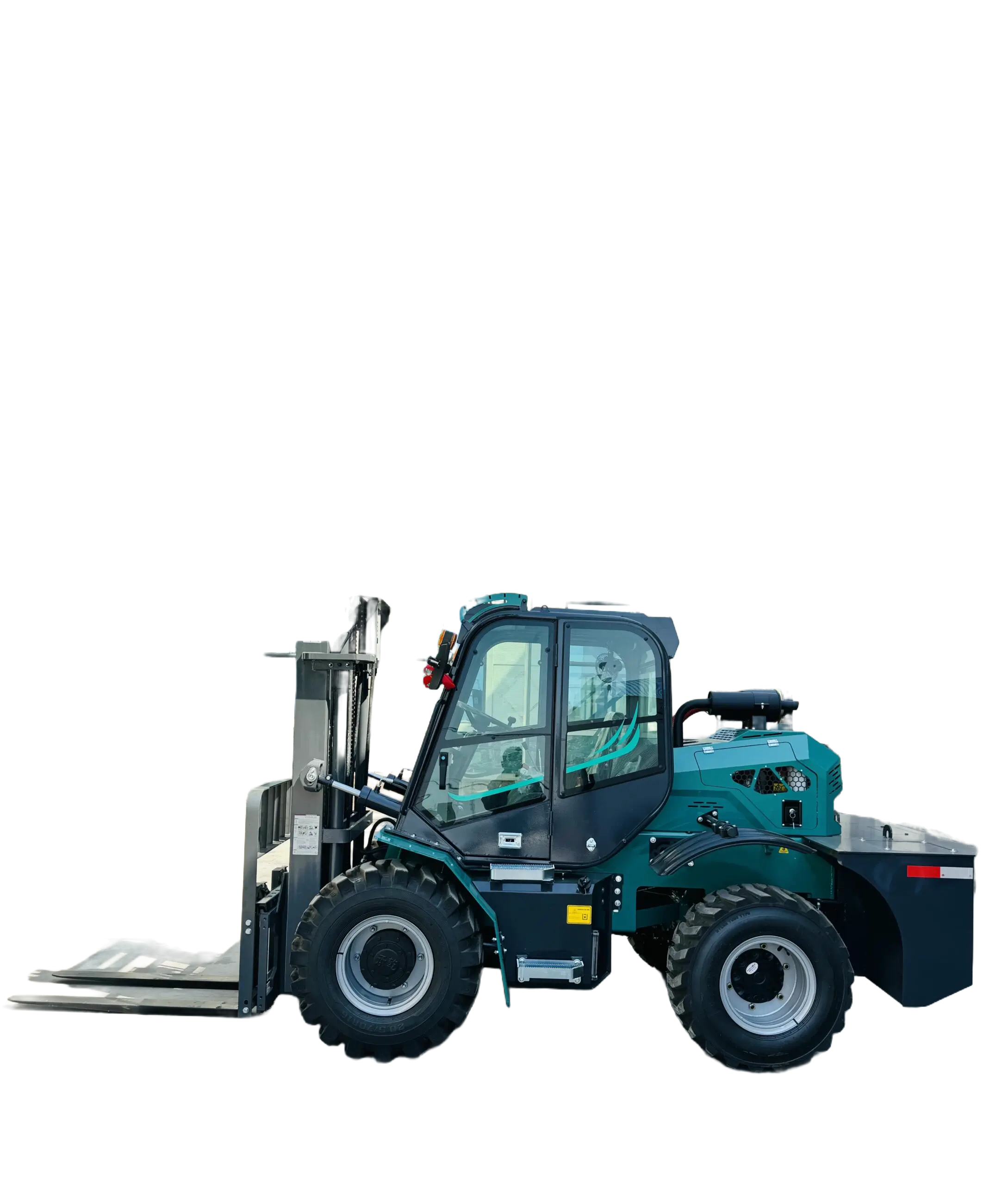
Three outdoor yards can buy the same 3.5-ton forklift and obtain completely different results. A block yard needs tight, repeatable travel over compacted gravel. A construction-material dealer crosses from paved storage to an uneven loading area. A timber yard handles long packs that change the load centre. An all terrain forklift manufacturer should answer each route separately rather than describe one machine as suitable for every rough surface.
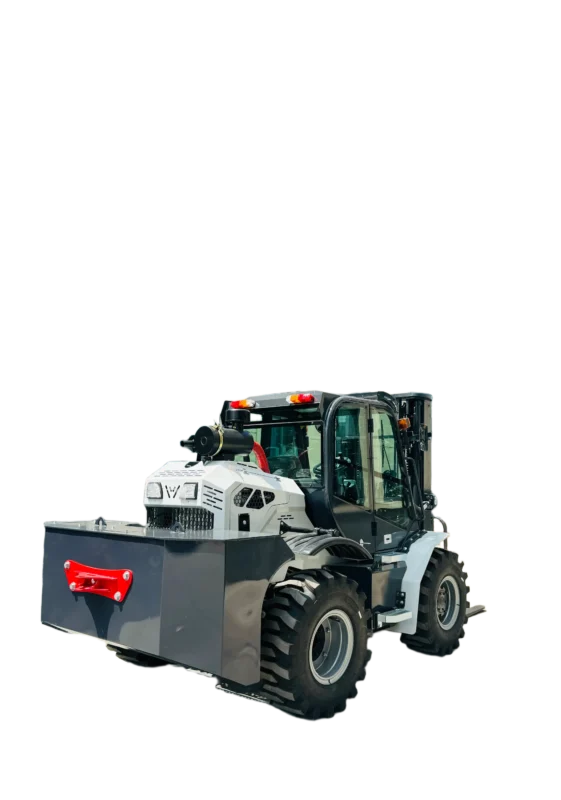
MEGA’s all-terrain forklift family contains MG3501, MG3550, MG3580, MG3581 and MG3582. All publish a 3,500 kg class and 36.8 kW engine direction, but their pages list different weights, dimensions, transmissions, tires and steering values. Before choosing among them, document the load geometry, mast height, doorway, grades, turns and ground preparation.
The 3.5-ton label applies only under the manufacturer’s defined conditions. A long pallet, clamp, tall mast or forward load centre can reduce approved capacity. Likewise, 4×4 traction can help a forklift move across loose ground, but it cannot make a raised load stable during a turn.
Use the same scale for each drawing. Mark pickup and set-down points, load direction, longest pallet, doorway, turning aisle, slope, soft shoulder, pedestrian crossing and surface change. Add the mast’s collapsed height and the outer sweep of the load.
The block yard handles stable palletised units over short distances. Its main questions are load mass and centre, fork spacing, turning space, stacked height and tire behavior on compacted gravel. The yard should provide a level pickup and stacking lane, because broken blocks under a tire can tilt the machine at the worst moment.
The MG3501 publishes a 3,500 kg load at a 500 mm load-centre distance, 3,000-6,000 mm lift-height range and 3,400 x 1,800 x 2,250 mm dimensions. Its minimum turning radius is listed as 2,200 mm, with 23.5/70-16 tires and 300 mm wheelbase ground clearance.
This provides a clear starting geometry. The buyer still needs the exact mast, collapsed height, capacity at stacking height and load centre for the block pack. If a taller mast is selected, do not assume the lowest listed gantry height remains applicable.
The construction-material dealer may unload trucks on pavement, travel over a transition and place goods outside. The surface change can create wheel drop or load movement. Repair the transition, establish one travel lane and keep the load at the manufacturer’s approved low travel position.
The MG3550 publishes full-hydraulic 4F/4R transmission, 4,700 kg operating weight, 1,750 mm wheelbase and 230 mm ground clearance. It lists 20.5-16 front and 12-16.5 rear tires, a 50-degree steering angle and 2,200 mm minimum turning radius.
This configuration may appeal where predictable direction changes and a defined yard route matter. The dealer should verify that mixed tire sizes, braking system and mast fit its service support. A transport or parts plan based on MG3501 tire data would be wrong.
Timber packs can project far beyond the fork face, vary in density and shift if banding is poor. The yard should provide verified mass, pack length, centre of gravity and entry direction. Fork length and spacing must support the load, and an approved clamp or other attachment may be needed.
MG3581 lists 1.22 m standard forged forks, a custom multi-stage mast, 20.5/70-16 tires and a four-caliper dual-booster braking system. Its page also gives 5,000 kg machine weight varying by configuration. None of those facts confirms capacity for a particular timber pack. Send the load drawing for manufacturer approval.
The five pages contain repeated language, so the buyer should not manufacture distinctions that are not documented. Copy values into a table, mark options and leave missing fields blank. A difference is only useful when it affects the real yard.
| Published field | MG3501 | MG3550 | MG3580 | MG3581 | MG3582 |
|---|---|---|---|---|---|
| Rated class | 3,500 kg | 3,500 kg | 3,500 kg | 3,500 kg | 3,500 kg |
| Overall length | 3,400 mm | 3,400 mm | 3,200 mm | 3,400 mm | 3,400 mm |
| Published weight | 4,500 kg | 4,700 kg | 5,300 kg | 5,000 kg, varies | 4,500 kg |
| Ground clearance | 300 mm wheelbase / 240 mm gantry | 230 mm minimum | 230 mm minimum | 230 mm minimum | 230 mm minimum |
| Listed turning radius | 2,200 mm | 2,200 mm | 500 mm | 500 mm | 500 mm |
The MG3580 publishes 3,200 x 1,800 x 2,250 mm dimensions, 5,300 kg operating weight and “4 x 4 drive with mid-speed selection.” It uses 20.5-16 tires front and rear. A shorter listed length may help a yard, while additional weight affects transport and ground.
Ask for the actual transmission description, service information and current drawing. Its 500 mm listed turning radius is inconsistent with the 2,200 mm values on MG3501 and MG3550 and appears unusually small for the dimensions. Keep it unconfirmed until a measured demonstration or corrected document is supplied.
MG3581 publishes an 80-degree steering angle, central differential with switchable floating axle/full-time 4WD, and 3,400 x 1,800 x 2,250 mm dimensions. MG3582 lists an 80-degree steering angle, high/low-speed 4×4 drive and 3,400 x 1,800 x 2,500 mm dimensions.
Both list a 500 mm minimum turning radius. Before drawing aisles from that value, place the offered machine on a level marked pad and measure its outer tire, counterweight and load paths. Include the pallet because a long load can create the widest sweep.
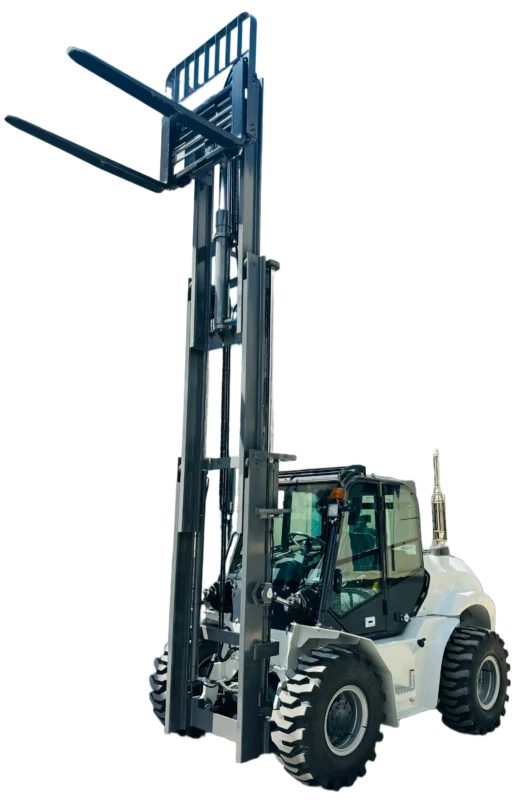
Maximum travel speed attracts attention, but the buyer’s limiting event is often a tall placement or long load. Freeze the exact mast, fork and attachment first. Then establish travel speed for the route under manufacturer guidance and local rules.
MG3550, MG3580, MG3581 and MG3582 use custom multi-stage mast wording rather than one fixed height. State required fork height, free-lift need, collapsed mast height, overhead guard height and highest doorway. Ask for capacity at the selected height and real load centre.
If outdoor stacks are tall but the forklift later enters a low warehouse, the two requirements may conflict. A mast option can solve one while failing the other. The quotation should show the selected configuration on a drawing.
MG3501 lists optional buckets, clamps, forks and boom tools. For any attachment, obtain its identity, mass, forward centre, hydraulic needs and revised capacity. Attachments can also change length, visibility and turning envelope. Include them in factory and receiving inspection.
OSHA’s forklift load-handling material explains general load stability and handling principles. It does not approve a particular MEGA configuration or replace local requirements. Use manufacturer data and competent site procedures for the actual machine.
A generic start-and-drive video cannot prove three applications. Define one safe cycle for the intended yard and identify the load, surface and measurement. The manufacturer should state what it can demonstrate before shipment.
Use an approved representative pallet with known mass and centre. Check fork entry, mast operation, brake response, steering and placement height on a level surface. Record the collapsed and raised mast. Do not create an unsupported test on a slope.
Inspect the buyer’s transition at commissioning rather than trying to reproduce a dangerous obstacle at the factory. Factory evidence can cover travel, steering, brakes and ground clearance on a controlled route. At the destination, first cross the prepared transition unloaded, then follow the approved commissioning plan.
If the actual timber pack is unavailable, use a manufacturer-approved test load with documented mass and centre. Verify the selected attachment and capacity information. Train operators not to treat visually similar packs as equal when length or moisture changes.
The same 3.5-ton class can create different wear and inspection priorities. Dusty block handling, wet gravel transitions and timber attachments affect tires, brakes, mast cleaning, hydraulic connections and daily observations differently. Ask the manufacturer for the delivered maintenance schedule, then adapt workshop planning without overriding it.
Set a cleaning method that keeps the operator platform, steps, mast channels and identification visible. Inspect fork locking, heel condition, chains, rollers, hoses and brakes according to the manual. Do not use compressed air or washing practices that the supplier prohibits. The goal is to see deterioration before another pallet is raised.
Record tire damage from broken material and keep the stacking lane clear. If the forklift repeatedly strikes debris, improve housekeeping rather than treating tire replacement as normal production cost.
Photograph the pavement-to-gravel point at commissioning and inspect it after rain or heavy trucks. Settlement can create a step that was not present during selection. Repair the surface before the forklift begins pitching with loads.
Use the same machine identity for service records, parts and any transmission or axle work. MG3550’s full-hydraulic 4F/4R wording and mixed tire sizes need configuration-specific parts support.
A clamp, long fork or other attachment should have an identified inspection and maintenance route. Record hydraulic leaks, locking, wear and any change in capacity information. If the attachment is transferred to another model, obtain approval rather than assuming a common mounting point creates compatibility.
Rain can soften a shoulder, storage can narrow an aisle and a new product can lengthen the load. Give the supervisor authority to stop the route when its assumptions change. Daily checks should include tires, forks, mast, chains, hydraulics, brakes, steering and warning devices under the delivered manual.
The final all-terrain forklift choice may differ across the three yards even though each starts at 3.5 tons. MG3501 offers a published 500 mm load-centre reference and broad mast range; MG3550 has its own transmission and tire route; MG3580, MG3581 and MG3582 need clarification of their tight-turn figures and specific drive configurations. Select the evidence-backed fit, not the model with the most aggressive single number.
Review the original yard drawing after the first month. Compare actual pallet lengths, routes, door clearances and declined lifts with the purchase assumptions. A successful review may confirm the configuration; a mismatch should change the site or handling plan before it becomes a routine workaround.
Keep a change log for loads as well as the machine. When a block supplier changes pallet depth, a dealer moves storage onto softer ground or a timber pack gains length, revisit capacity and route. Photograph the new condition and obtain manufacturer guidance where needed. This prevents a forklift selected correctly for the original yard from being blamed for an undocumented application change.
Review declined lifts with sales and operations. Repeated rejection may justify another mast, attachment or machine, but it should never pressure an operator to bypass the approved configuration.
Distributors turning the chosen route into inventory can follow the rough-terrain forklift first-shipment plan.
