

Get quote
Get Free Consultation!
We are ready to answer right now! free consultation.
A dealer can stock eight dumper models and still fail to cover its market clearly. Customers do not buy model-code variety; they buy a machine for a material, route and tipping point. When working with a site dumper supplier in China, distributors should build a few distinct stock roles, document where each one stops fitting, and add nearby capacities only after real demand appears.
MEGA currently publishes eight site-dumper pages: compact MG10D and MG10DB routes, 2- to 6-ton steps, and a 10-ton MG100D. A practical opening stock can separate compact swivel-skip work, mid-payload 4×4 construction haul and higher-capacity open-site movement. The first confirmation is the dealer’s customer mix—landscapers, utility contractors, rental fleets, builders or civil projects—and the common route constraints in its region.
Review the site dumper catalog with three columns beside every model: ideal customer, rejection condition and parts/support requirement. If two models receive the same answer, the dealer has not yet justified stocking both.
The compact role serves confined access, landscaping, utilities and small building work. The middle role supports contractors hauling soil, aggregate or spoil over unpaved site routes. The upper role serves open sites where fewer, larger cycles justify more payload and a larger machine envelope.
These are sales roles, not promises that one model fits every customer in a segment. Staff should still collect material, density, route, slope, width, turn and tipping information before confirming a unit.
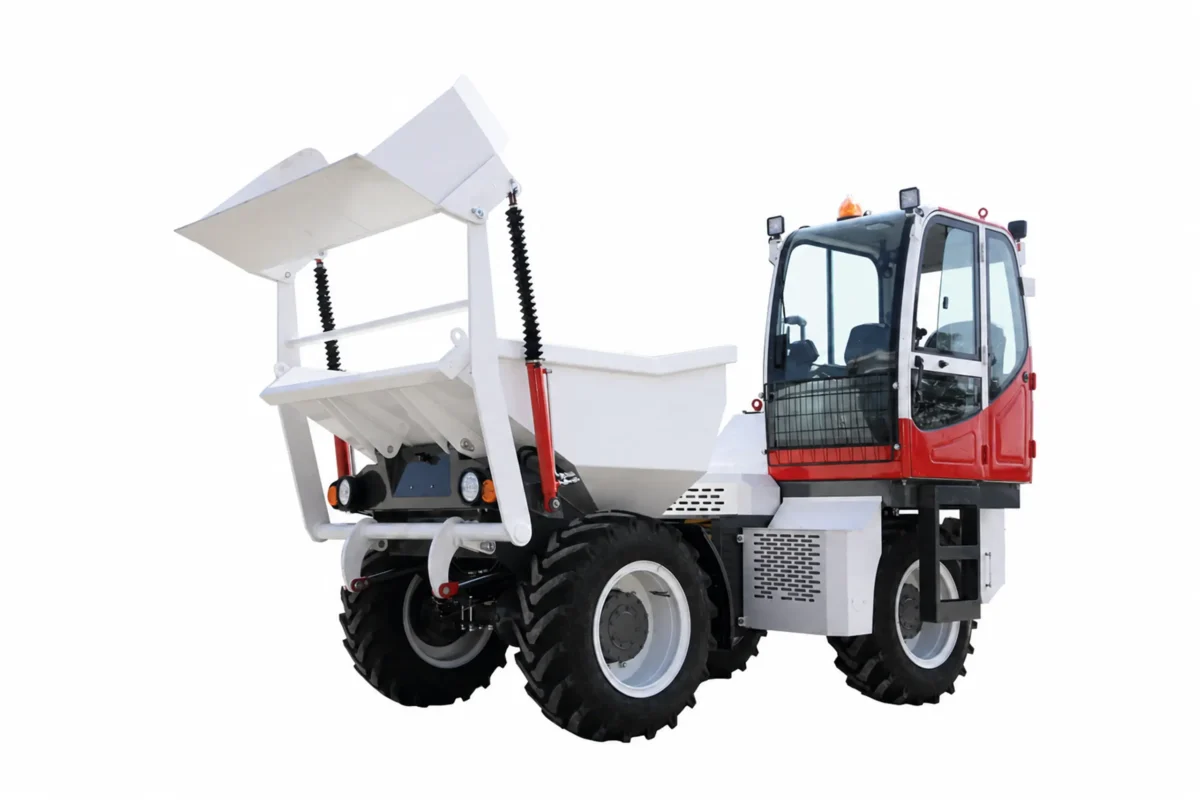
The MG10DB is described as a compact swivel-skip dumper. Its page lists a 1,300 kg rated load, 1,500 kg maximum load, 0.5 m³ level capacity, 0.65 m³ heaped capacity, plus-or-minus 90-degree skip rotation and 12 km/h maximum speed. Published overall wheel width is 1,046 mm.
That combination gives a dealer a clear conversation: narrow route, controlled short haul and side-discharge need. It should not be presented as a substitute for a 3- or 6-ton open-site dumper. Ask about dense materials, because the skip can reach payload before it appears full.
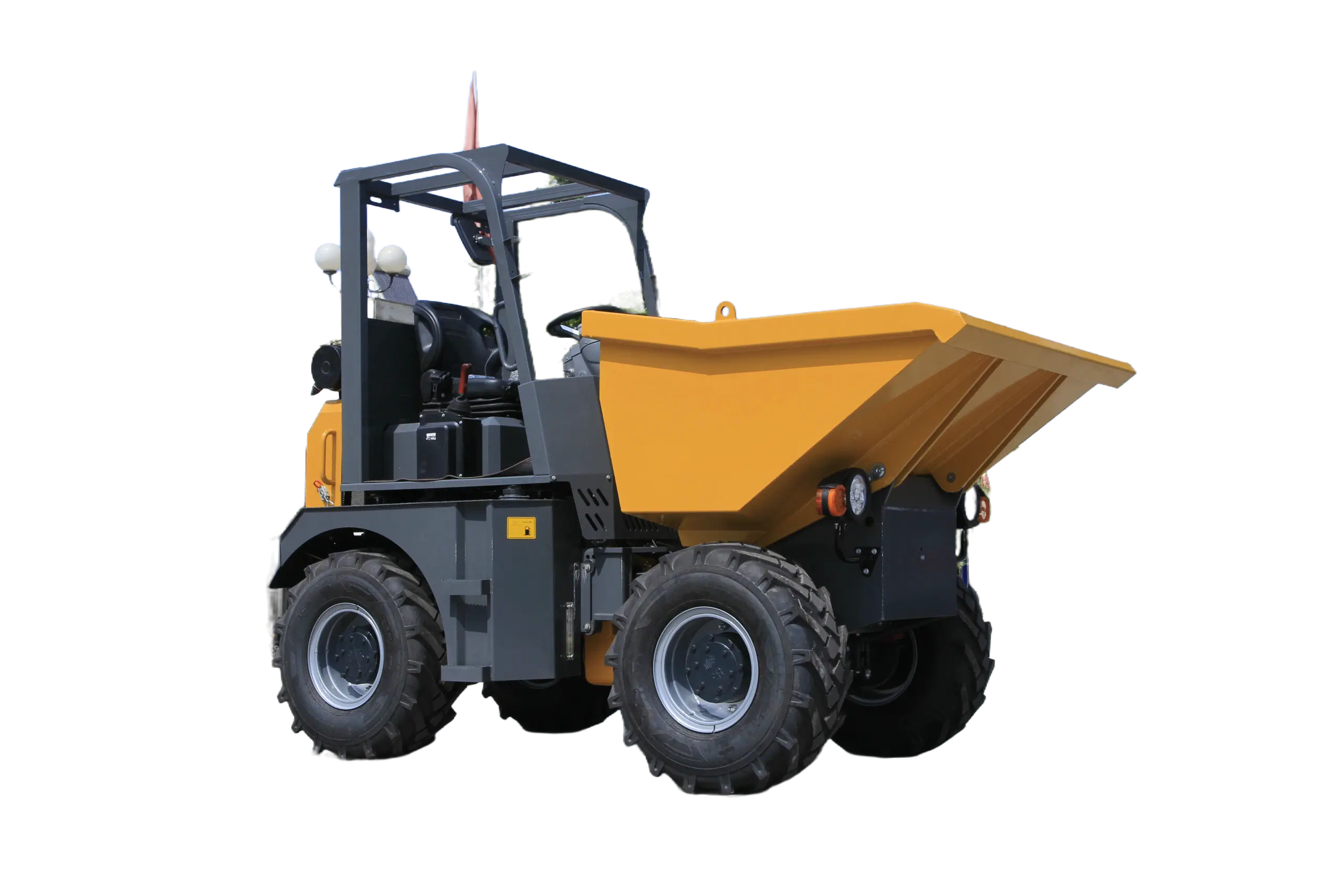
The MG40D publishes a 4,000 kg rated load, 1.6 m³ bucket, four-wheel drive, 250 mm minimum ground clearance, 23.5/70-16 tires and a 4,500 mm minimum turning radius. Its overall dimensions are listed as 4,900 by 1,850 by 2,700 mm.
This may fit a dealer whose customers need more payload than a compact dumper but still work on moderate-width sites. If local demand is concentrated around 2 or 3 tonnes, MG20D or MG30D may create a more useful middle tier. The decision should follow customer records, not an arbitrary progression.
Higher payload changes transport, storage, demonstration and customer screening. A dealer should not bring in a larger unit simply because its per-ton purchase price appears attractive. It needs customers with suitable routes and a service plan for the installed engine, axles, brakes and tires.
| Stock role | MEGA example | Published differentiator | Customer question before sale |
|---|---|---|---|
| Compact swivel-skip | MG10DB | 1,300 kg rated; 0.65 m³ heaped; ±90° skip | Is the priority narrow access and controlled side tipping? |
| General 4×4 haul | MG40D | 4,000 kg; 1.6 m³; 1,850 mm width | Does material density and route justify four tonnes? |
| Upper midrange | MG60DA | 6,000 kg; 2.5 m³; 320 mm clearance | Can the site turn, support and transport this class? |
| Highest published route | MG100D | 10,000 kg; 3 m³; six tires | Is this a controlled construction-site haul, not road or mining work? |
The MG60DA lists a 6,000 kg rated load, 2.5 m³ bucket, 4,200 kg total weight, four-wheel drive, 16/70-20 tires and 320 mm minimum ground clearance. Its width is published at 2,361 mm, with a 4,850 mm minimum turning radius.
A rental business may use it for larger construction routes, but transport and yard handling must be planned. A dealer demonstration should include the actual skip option and current controls. Staff should never imply that the published payload guarantees safe operation on a customer’s slope.
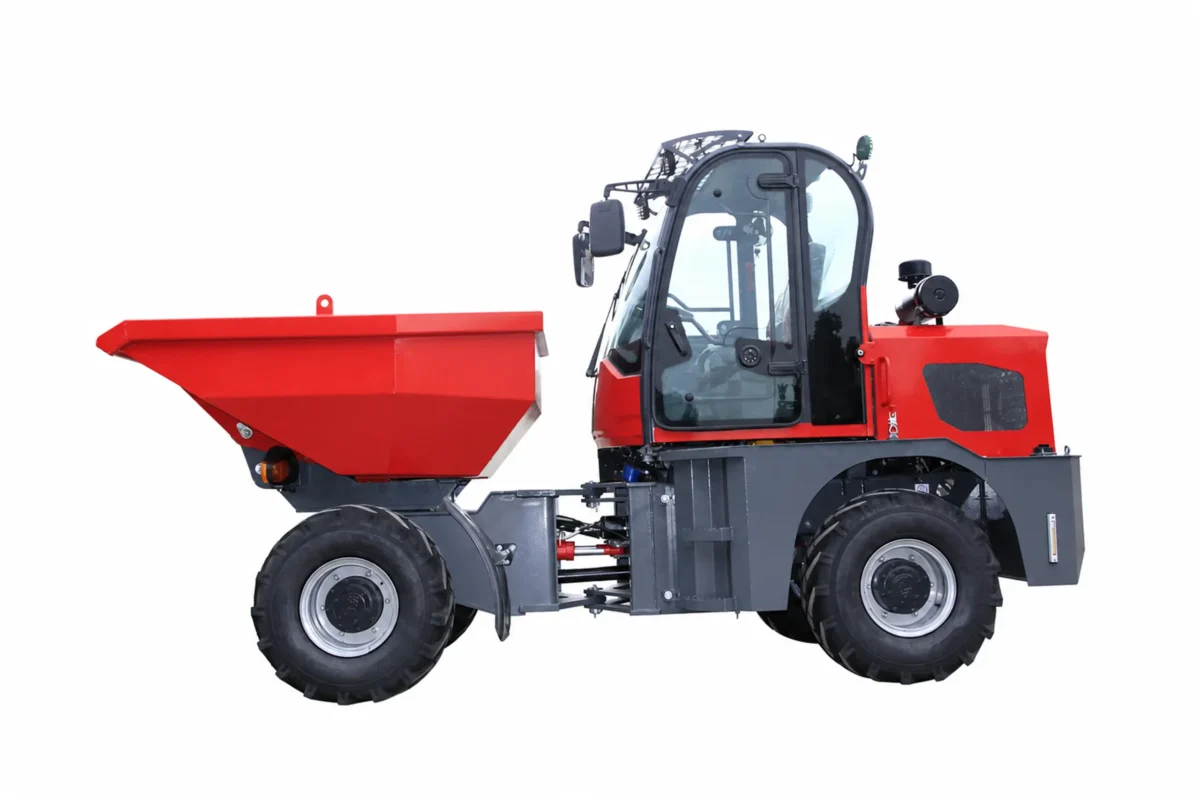
The MG100D lists a 10,000 kg rated load, 3 m³ bucket, 6,500 kg machine weight, six 16/70 R22.5 tires and 390 mm minimum ground clearance. It is the largest published MEGA site-dumper route, but it remains a construction-site dumper in this catalog.
Dealers should describe its intended controlled-site work and verify the customer’s route, tipping and transport. Do not market it as a public-road truck or mining hauler without separate, authoritative evidence that is not present in the current product information.
Two customers asking for “four tonnes” may need different machines. One moves dense broken material over a flat hard route. Another moves wet soil across soft, narrow ground. The dealer should record volume, density, loader bucket, cycle distance, gradient, turning and discharge.
Landscaping customers may value compact width, swivel tipping and gentle site access. MG10DB can lead that range, with MG20D as a step for more payload. A civil-equipment dealer may start with MG30D or MG40D and place MG60DA above it.
Using one national stock plan for every branch can create slow inventory. Let customer applications decide which role gets a physical unit and which model remains an order-on-demand alternative.
Create a pre-rental form for material, site address, pedestrian controls, route width, gradients, edge conditions and tipping point. Match the form to the supplied manufacturer limits and local rules. Record condition, loose items and controls at handover and return.
The U.K. Health and Safety Executive’s dumper guidance identifies overturning and collision as major hazards and emphasizes selection, training, traffic separation, daily checks and safe gradients. Local obligations vary, but a dealer can use these topics to improve customer screening without claiming the guidance replaces MEGA’s manual.
A dealer cannot train staff or stock parts around a page that lists alternatives without identifying the imported unit. The purchase order should name engine, power, axle, gearbox, tires, skip route, cabin or protection, dimensions and included spares. If the supplier proposes a component change, require written approval before production.
Several larger MEGA dumper pages describe a plus-or-minus 90-degree tipping bucket as optional. The dealer’s sales material must match the imported unit. Demonstrate only the functions actually supplied, and show the exact machine during pre-shipment inspection.
If one stock unit rotates and another does not, label them clearly. A customer should not discover at delivery that a gallery image represented an option.
Ask for filters, seals, hoses, brake items, wear parts and service references tied to the installed components. The MG10DB can list a Kubota D1105 or V1505 route, while larger models publish other engines and axles. The dealer needs the actual installation.
Build stock around expected maintenance and local lead time. Do not order expensive contingency components without understanding failure mode, storage and application. A smaller, identified package is more useful than unlabeled parts.
Before shipment, request model-linked photographs and functional records. Reconcile model plates, tires, skip mechanism, loose items and documents. The packing list should allocate every item to a unit. If several dumpers share a container, colour or position alone is not identification.
Plan parking, battery or fluid maintenance, demonstration area, wash control and pedestrian separation. Larger MG60DA and MG100D units need different space from MG10DB. Do not start or demonstrate machinery in a congested showroom area.
Preserve tires and exposed components during storage according to manufacturer guidance. Record periodic checks and keep manuals accessible to the service team.
Give staff examples: dense material overloads a high-volume skip; the route cannot turn the larger model; an edge lacks a safe tipping zone; the customer expects public-road work; or no trained operator and traffic plan exists. A correct rejection protects the customer and the dealer.
After every qualified demonstration, record the customer’s material, route and reason for selecting or rejecting the model. Do not turn that record into a claimed customer case without permission. Internally, it shows whether the compact unit loses sales on payload, the middle unit loses on width, or the upper unit loses on transport.
The service team should add its own observations: which filters and wear items customers request, which controls need repeated explanation, and which loose accessories are commonly misplaced. Purchasing can then adjust the next parts package and handover documents. This feedback is more reliable than ordering the model that attracted the most showroom attention.
If the supplier offers different engines, tires or skip options under one model, build an approved configuration card for the imported unit. Staff should quote from that card, not from a web page containing all possible alternatives. The card can state model, rated load, skip, dimensions, installed components, included option and current evidence date.
When a customer requests another configuration, open a new supplier confirmation rather than editing the stock card. This prevents a special-order feature from being promised on an existing yard machine.
Track lost sales by reason. If customers repeatedly need a 2-ton step below MG40D, add MG20D. If they need a 5-ton route between MG40D and MG60DA, review MG50D. If most upper-capacity requests fail transport or site screening, do not let headline demand create stagnant stock.
Share this application pattern with the site dumper supplier in China. The supplier can recommend current configurations and spares more effectively when the dealer provides real material and route information rather than asking for “best sellers.”
Review aged inventory quarterly. If a model has not moved, test whether its intended customer is unclear, its transport is difficult, or a neighbouring model covers the same role. Moving the unit through better qualification is preferable to discounting it into an unsuitable application. If the role itself is weak, reduce that position in the next order.
For repeat shipments, compare model plates, engines, tires, skip hardware and manuals with the first delivered unit. A supplier change can be manageable when documented early. Silent variation makes parts stock, training and resale records less dependable.
A disciplined initial range may contain only MG10DB, MG40D and MG60DA, with MG100D supplied for qualified open-site projects. Another market may choose MG20D, MG30D and MG50D. The exact ladder can differ; the rule stays the same. Every stock model needs a customer, a rejection boundary, identified parts and a route the dealer can explain.
Document clearly why each unit entered stock and review that reason carefully after six months. A changing local project mix may justify a different middle payload or a compact electric alternative. Inventory should follow qualified applications, while the configuration record preserves support for machines already sold.
Before approving the first order, compare supplier files through the verifiable dumper data method.
