

Get quote
Get Free Consultation!
We are ready to answer right now! free consultation.
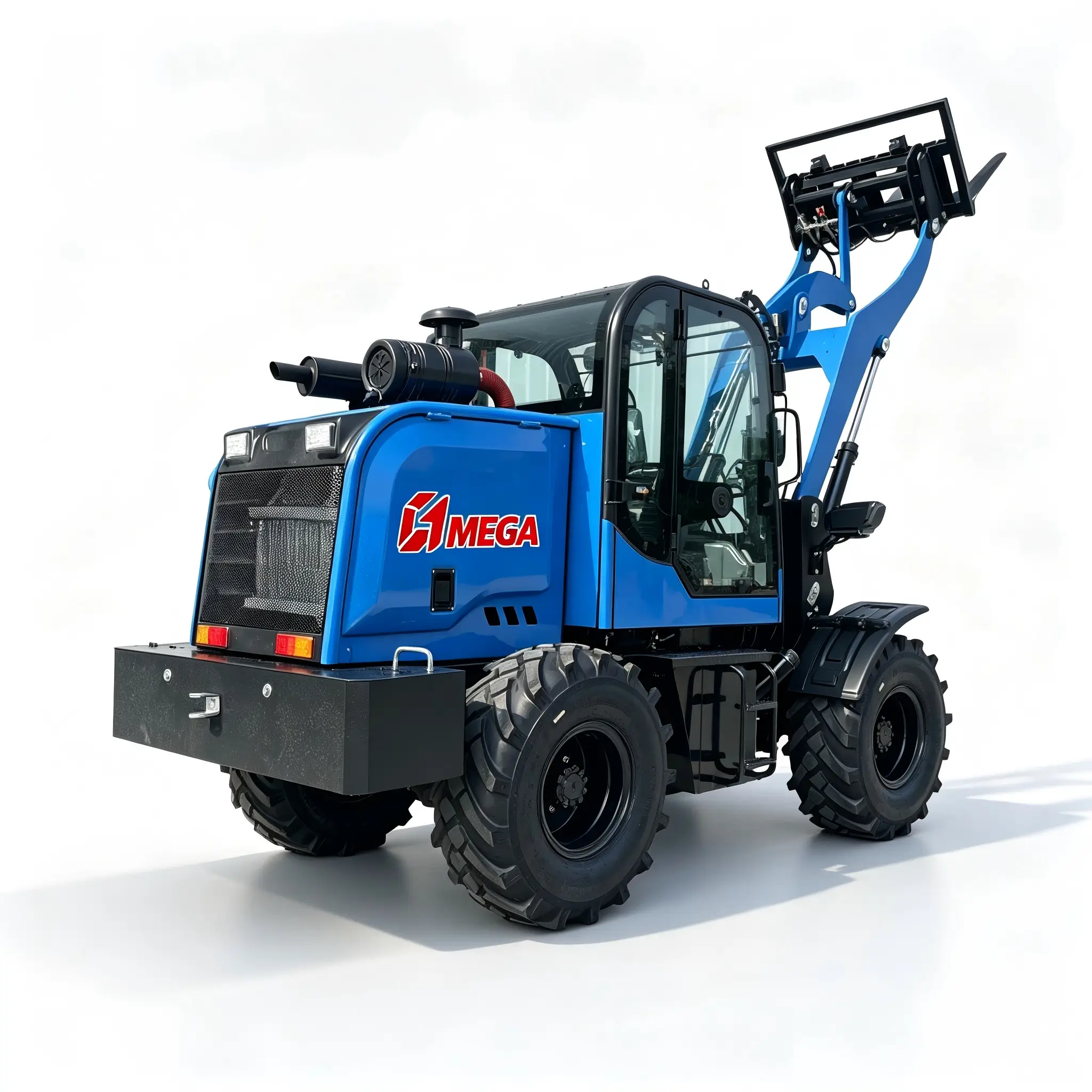
A loader that can lift the rated payload may still be unable to clear the truck side, and a bucket that looks large may overload the machine with dense material. Wheel loader manufacturer selection should connect five values: rated load, bucket volume, material density, dumping height and dumping reach. Add the route and turning space, and the buyer has a useful shortlist.
MEGA publishes wheel loaders from an 800 kg compact MG910C through 1-ton, 2-ton, 2.5-ton and 3-ton routes. Contractors, farms and material yards should first identify the normal material and receiving point. A feed yard handling light bulk material needs a different bucket decision from a contractor loading damp aggregate. Review the wheel loader family only after those two facts are written.
The manufacturer’s rated data defines an envelope, not hourly production. Bucket fill, operator, travel distance, ground and receiver alignment affect every cycle. Choose a model that handles the normal job without using its maximum as the routine target.
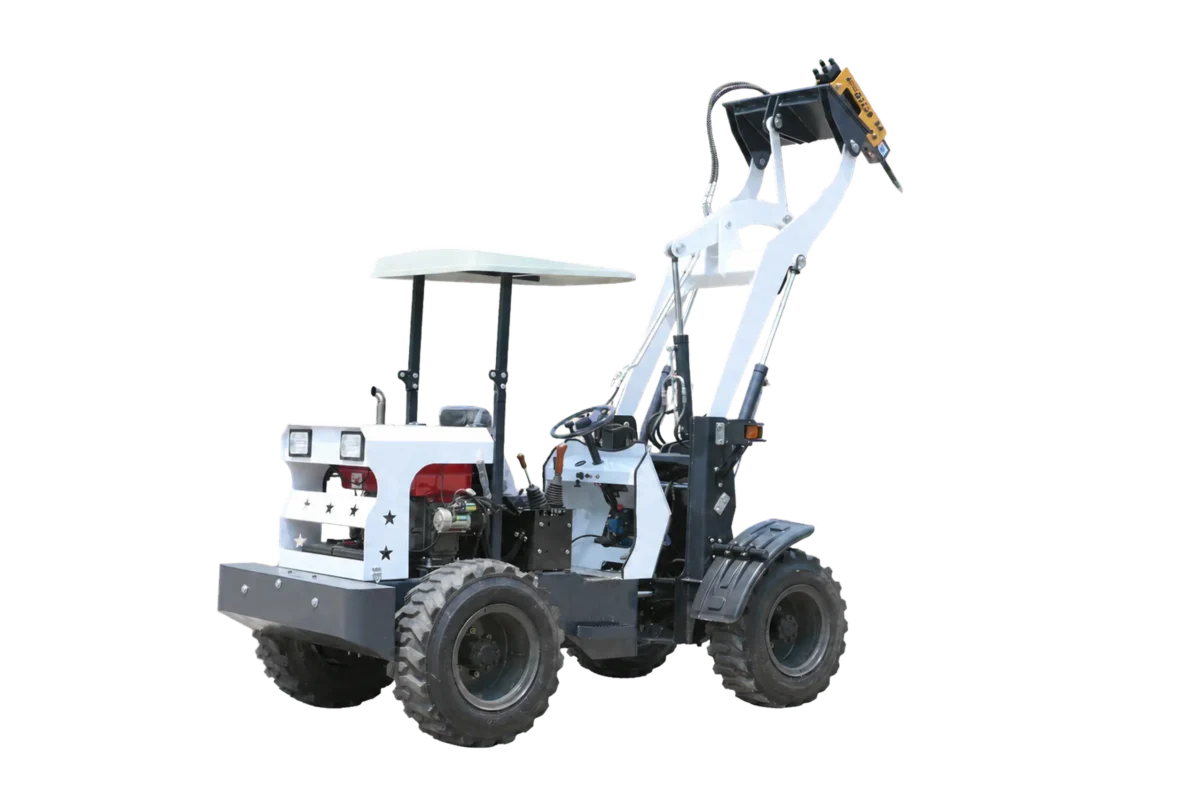
Estimate the mass of a bucket from loose density, bucket volume and a realistic fill factor. Dense wet sand, gravel and broken material can reach rated payload in a smaller volume than compost, grain or dry wood chips. Do not select the bucket from cubic metres alone.
Ask the manufacturer which bucket type and assumed density underlie the published rating. If a light-material bucket or high-tip bucket is requested, obtain the changed dimensions and capacity limits. A larger bucket may be correct for light material and wrong for aggregate.
The MG910C publishes an 800 kg rated load, 1,500 kg operating weight, 0.3–0.5 m³ bucket range and 1,300 mm bucket width. It lists a 2,400 mm dumping height, 802 mm reach, 20 kW engine and 4×4 manual mechanical drive.
Its overall dimensions are 4,180 by 1,300 by 1,980 mm. Those numbers can suit narrow yards and low structures. They also set a clear boundary: the machine should not be sold for production duties that require a larger payload, heavier axle or wider bucket.
The MG910 lists a 1,000 kg rated load, 0.4 m³ bucket, 1,400 mm bucket width, 2,300 mm dumping height and 750 mm reach. It publishes a 45 kW engine, articulated chassis with 35-degree articulation and 4×4 hydraulic articulated steering.
The page lists a 2.0 m minimum turning radius and overall dimensions of 3,300 by 1,500 by 2,350 mm. Compare those values with MG910C’s height and width. The correct compact choice depends on gate, roof, receiver and material—not merely the extra 200 kg.
Dumping height is not the same as clearance over every receiver. Bucket lip, dump angle, reach and machine position determine whether material enters cleanly. Obtain a current dimensional drawing for a critical hopper or truck.
| MEGA route | Rated load | Bucket | Published dump geometry | Typical question |
|---|---|---|---|---|
| MG910C | 800 kg | 0.3–0.5 m³ | 2,400 mm height; 802 mm reach | Can it pass the gate and clear a low receiver? |
| MG910 | 1,000 kg | 0.4 m³ | 2,300 mm height; 750 mm reach | Does tight turning outweigh the lower published height? |
| MG936 | 2,000 kg | 1.2 m³ | 3,500 mm height; 1,000 mm reach | Does the bucket match dense site material? |
| MG958 | 2,500 kg | 1.5 m³ | 3,500–4,500 mm height; 805 mm reach | Which height configuration is quoted? |
| MG940 | 3,000 kg | 1.2 m³ | 3,500 mm height; 1,000 mm reach | Is payload needed with this bucket volume? |
The MG936 publishes a 2,000 kg rated load, 1.2 m³ bucket, 2,000 mm bucket width, 3,500 mm dumping height and 1,000 mm reach. It lists a 78 kW engine, automatic 4F/4R transmission, articulated chassis and 16/70-20 tires.
This route may suit general construction, aggregate handling and yards with enough width. The buyer should verify the material density assumed for the 1.2 m³ bucket and the current engine option. The page lists several optional engine directions and notes that parameters can change, so the order must freeze the actual configuration.
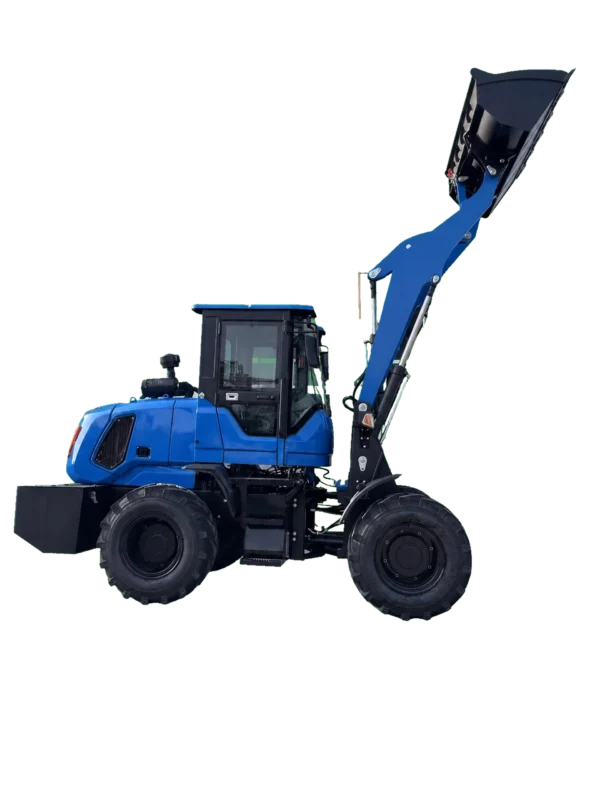
The MG958 lists a 2,500 kg rated load, 1.5 m³ bucket and 3,500–4,500 mm dumping height. The MG940 lists a 3,000 kg rated load, 1.2 m³ bucket and 3,500 mm dumping height. A buyer should not assume the higher-payload MG940 also has the larger bucket.
For dense aggregate, payload can matter before volume. For light material or a high receiver, the MG958’s bucket and height route may be more relevant. Ask which specific height configuration is included, because a range needs selection before price and access are compared.
A feed or compost yard may handle light material, work under roofs and turn among bins. It can value compact height and bucket volume. A construction yard may handle dense aggregate, load trucks and travel on rough ground, making payload, axle, brakes and tire route more important.
Suppose a buyer wants to enter a 2.1 m-high shed. The MG910C’s published 1,980 mm overall height may appear suitable, subject to actual configuration and safe clearance. MG910 at 2,350 mm would not fit the same opening. The buyer should also measure bucket path and receiver, not only cabin height.
If the material is very light, ask for a compatible larger-volume bucket and changed dimensions. Do not use a large bucket for dense wet material without manufacturer approval.
The MG939 page publishes a 120 kN maximum breakout force, 92 kW engine, 3,100 mm dumping height and 1,060 mm reach. Those figures may suit another role from MG936 or MG940. Obtain the rated load and full current specification in a controlled sheet before comparison.
Approach angle matters. A loader can have sufficient height but insufficient reach to centre material over a high side without getting too close. Use a drawing or site test under controlled conditions.
Forks, grapples, high-tip buckets and other attachments change mass, load centre, visibility and geometry. The manufacturer should confirm compatibility and revised capacity. The data plate or supplied capacity information should reflect the working system where required.
A loader with forks can handle pallets in some applications, but the safe load at a given position is not simply the bucket rated load. Obtain manufacturer load information for the attachment. If repeated stacking and pallet handling dominate, compare the all-terrain forklift range rather than forcing a loader into every lift.
These attachments can increase discharge height or volume, but may reduce usable load or alter stability. Ask for revised overall height, dump height, reach and capacity. Include the exact bucket in factory inspection and packing evidence.
The general Yanmar V100 wheel loader information illustrates how manufacturers publish dimensions, turning and dump geometry together. Its figures describe Yanmar equipment, not MEGA. Use the field structure to improve questions without transferring data.
A specification comparison becomes useful when the buyer maps one complete cycle. Mark the stockpile face, pickup direction, travel lane, turning point, receiving edge and return path. Record the narrowest width, lowest overhead obstruction, ground condition and whether people or vehicles cross the lane. This exposes a bad shortlist before the buyer argues about engine brand or cabin trim.
A farm moving feed over 20 metres may spend more time aligning with a narrow bin than filling the bucket. An aggregate yard may lose time at the stockpile because dense material resists penetration. Trial timing should therefore separate pickup, loaded travel, approach, raise, discharge and reverse travel. A single unloaded demonstration cannot represent the normal duty.
Ask the manufacturer to identify the test bucket and material. Then compare the result with the ordered configuration. If the demonstration uses a smaller bucket, lighter material or a lower receiver, the apparent cycle cannot settle the buyer’s production estimate. The point of timing is to find the constraint, not to manufacture an attractive hourly number.
Published dumping height is only one part of clearance. The truck may sit higher when empty, the approach may slope, tire compression changes with load, and a soft edge can tilt the loader. Measure the receiving vehicle at the actual loading side and add a sensible operating margin. The bucket must clear while maintaining enough forward reach to place material rather than scrape the sideboard.
Where the MG936’s 3,500 mm dumping height and 1,000 mm reach appear suitable, request a dimensional drawing with the chosen bucket. Where the MG958’s listed 3,500-4,500 mm range is considered, identify which boom or configuration produces the quoted height. A range is not a delivered specification until the order selects one point.
Two loader quotations can use the same model name while including different engine, tire, cabin or bucket routes. The commercial comparison should therefore sit beside a configuration schedule, not replace it. Freight dimensions and loose attachments also matter because a tall cabin or wide bucket can change container planning and receiving work.
For sand or aggregate, ask the quotation to state bucket volume, width, cutting edge, assumed material and rated-load boundary. If a dealer requests a light-material bucket for another customer segment, give that attachment its own identification. The receiving team can then match the bucket to the intended material rather than relying on similar paint and dimensions.
For a low shed or narrow gate, preserve overall height and width, tire size, cabin form and any attachment projection in the approved drawing. Recheck these values before dispatch because options can alter the envelope. A few centimetres of undocumented change can turn a compact loader into an outdoor-only machine at the buyer’s site.
The order should name rated load, exact bucket, width, dump geometry, engine, transmission, axle, tires, brakes, steering, cabin route, options and destination requirements. Ask for a current dimensional drawing where access or receiver clearance is close.
Under manufacturer procedures, record start, travel, steering, service and parking brakes, boom raise, bucket rollback, dumping and visible hydraulic condition. A defined safe loaded test can be agreed where appropriate. Show model identity and the installed bucket.
On arrival, inspect transit condition, model plate, engine, tires, bucket or loose attachment, pins, hoses and documents before commissioning. Preserve the approved use and material in the handoff. A later operator should know whether the loader was selected for light bulk, dense aggregate, high-tip work or compact access.
The best wheel loader manufacturer recommendation is visible at the receiving edge. The selected machine carries the normal material without routine overload, clears the hopper with useful reach, turns on the route and arrives with a frozen attachment and evidence trail. MEGA’s MG910C, MG910, MG936, MG958 and MG940 provide distinct routes when buyers compare the complete geometry rather than one payload number.
Dealers translating these application boundaries into stock can continue with the Chinese wheel-loader supplier range plan.
