

Get quote
Get Free Consultation!
We are ready to answer right now! free consultation.
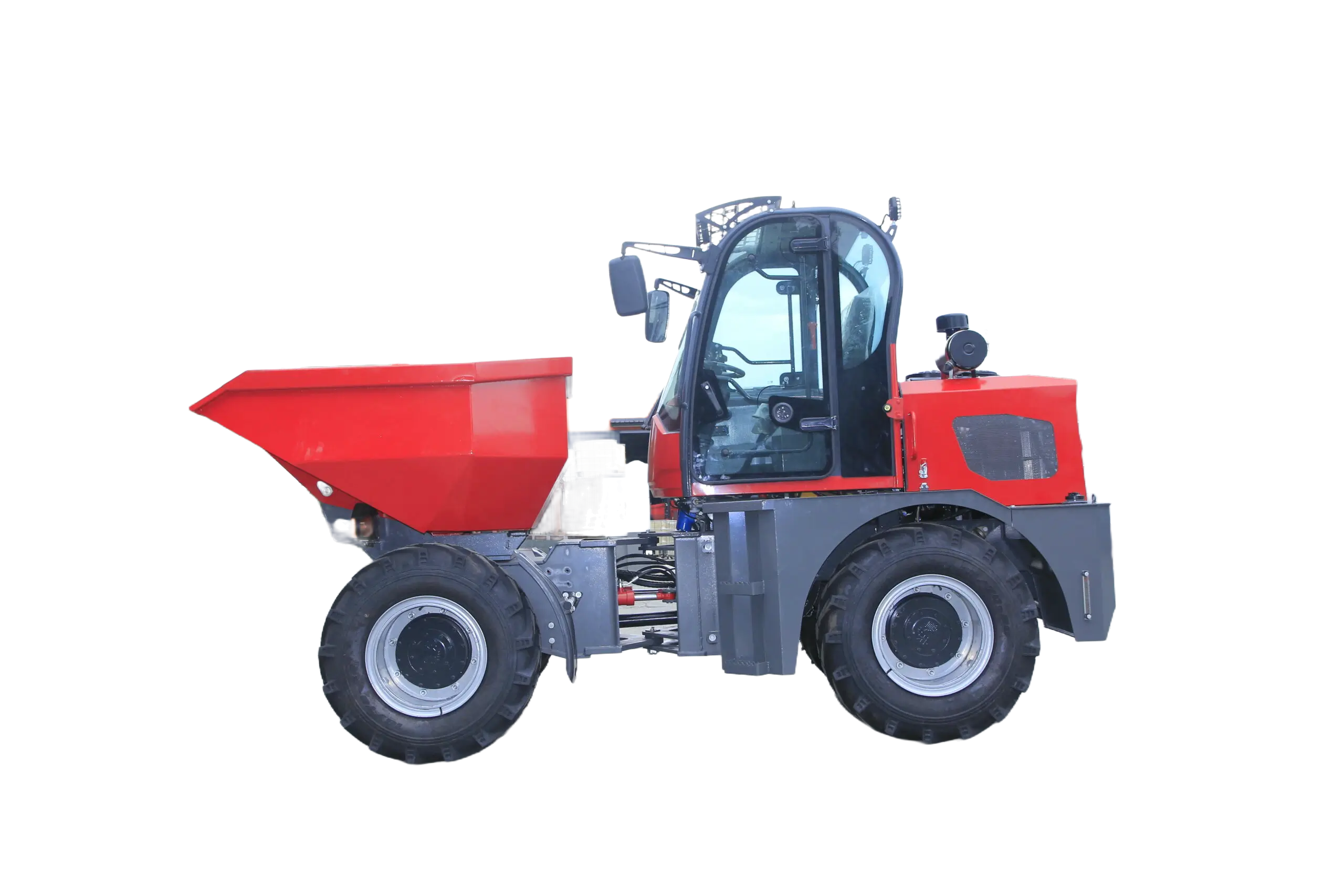
Four-wheel drive can help a dumper move on disturbed ground, but it cannot make an unstable slope, weak edge or overloaded skip safe. A buyer choosing a 4×4 site dumper manufacturer should survey the route first: material, payload, soft areas, ruts, gradients, turns, visibility and the exact tipping zone. Then select the smallest machine that completes the cycle with a usable margin.
MEGA publishes four-wheel drive on MG20D through MG100D. The pages also show differences in rated load, bucket volume, tires, ground clearance, width and turning radius. The first confirmation should be the model-specific safe gradient, because several current pages do not display a completed gradeability value. Do not borrow one model’s figure or treat 4×4 as an unlimited-slope statement.
This selection approach suits drainage, road, foundation and landscaping contractors working on unpaved routes. Review the site dumper family, map the loaded and empty paths, and keep pedestrians physically separated under the project’s local requirements.
Provide a plan and photographs showing the stockpile, loader position, loaded direction, passing points, gradients, water or mud, edges, tipping area and return. Mark the narrowest width and tightest turn. Record whether the route changes after rain or other construction activity.
Measure gradients rather than describe them as “small” or “steep.” Ask the manufacturer for the safe model limit and conditions, then operate within the manual and site controls. Side slope, surface, tire condition, load position and turning can matter even when the longitudinal grade looks acceptable.
Four-wheel drive describes the drive arrangement. Ground clearance describes geometry over obstacles. Tire footprint and pressure interact with surface support. Machine and load mass affect ground bearing. These are related but not interchangeable.
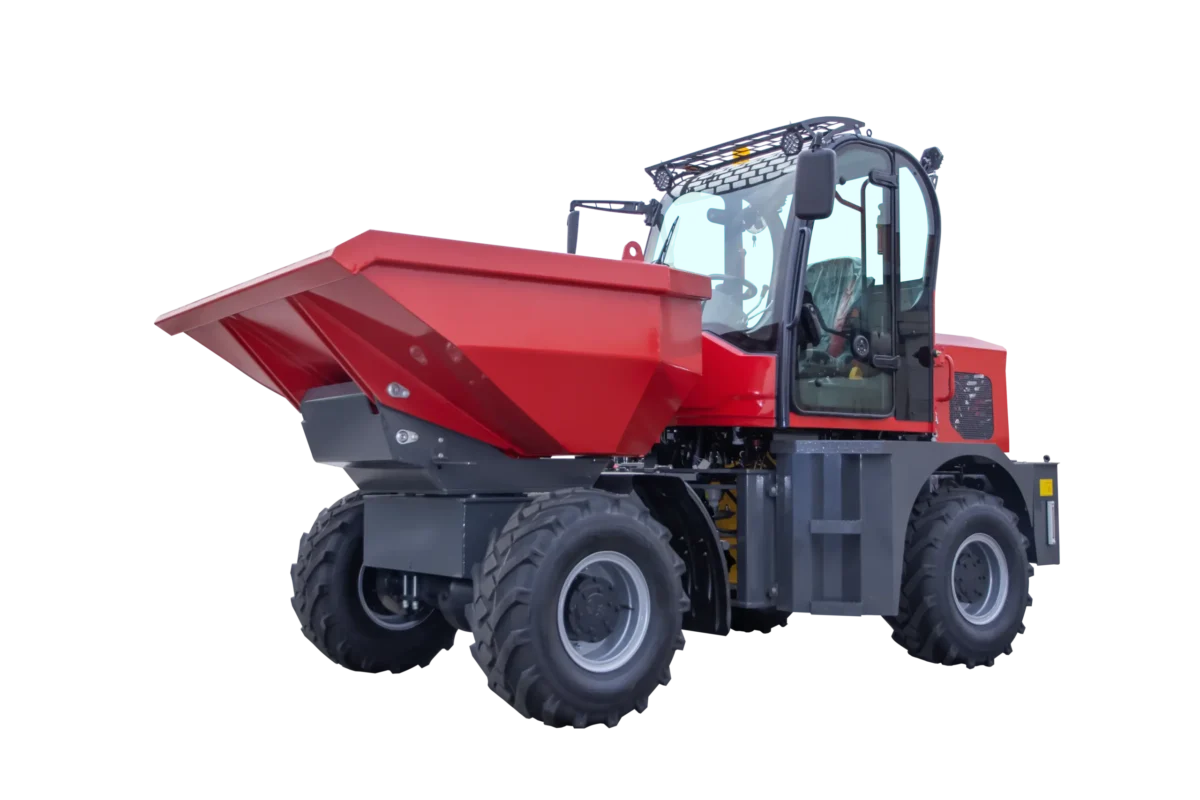
The MG20D lists four-wheel drive, 20.5/70-16 tires, 250 mm minimum ground clearance, a 2,330 kg total weight and 2,000 kg rated load. The MG50D lists 16/70-20 tires, 270 mm clearance, 3,500 kg total weight and 5,000 kg rated load. The larger machine does not automatically cross every soft area better; the route needs an engineering and manufacturer-informed assessment.
A loaded dumper has different weight distribution and stopping behaviour. The return route may climb where the loaded route descended. A one-way loop can reduce reversing but may introduce a side slope. Walk both directions and identify where speed, turning or passing must be controlled.
If a route has a weak culvert, slab or temporary crossing, use the appropriate total condition, not machine weight alone. Obtain current axle or load information where needed. A project should not infer bridge or slab suitability from tire size.
A larger payload reduces cycles only when the loader, route and tipping point can use it. Compare the complete cycle, not just tonnes per trip.
| MEGA model | Rated load | Bucket | Clearance | Published route clue |
|---|---|---|---|---|
| MG20D | 2,000 kg | 1 m³ | 250 mm | 1,630 mm width; 4,500 mm turning radius |
| MG40D | 4,000 kg | 1.6 m³ | 250 mm | 23.5/70-16 tires; 1,850 mm width |
| MG50D | 5,000 kg | 2.5 m³ | 270 mm | 16/70-20 tires; 4,850 mm turn |
| MG60DA | 6,000 kg | 2.5 m³ | 320 mm | 2,361 mm width; 4,200 kg machine weight |
| MG100D | 10,000 kg | 3 m³ | 390 mm | Six tires; 2,350 mm width |
Suppose a drainage contractor hauls spoil through a 1.8-metre corridor with passing areas. The MG20D’s published 1,630 mm width may leave a feasible envelope after a proper clearance review, while an MG60DA at 2,361 mm does not. More MG20D cycles can still produce the better day because the larger machine cannot enter.
Material density matters. A one-cubic-metre skip can approach a 2,000 kg load with dense material. The loader method should control mass rather than rely on a visually full skip.
Both publish a 2.5 m³ bucket and 16/70-20 tires. The MG60DA increases rated load to 6,000 kg and clearance to 320 mm, while its published width is 2,361 mm. The MG50D is 1,900 mm wide and lists 5,000 kg rated load.
The extra tonne and clearance may help on an open route, while the width may reject a confined one. Ask for current turning, braking, steering and gradient confirmation. The most useful comparison is one that allows either model to win.
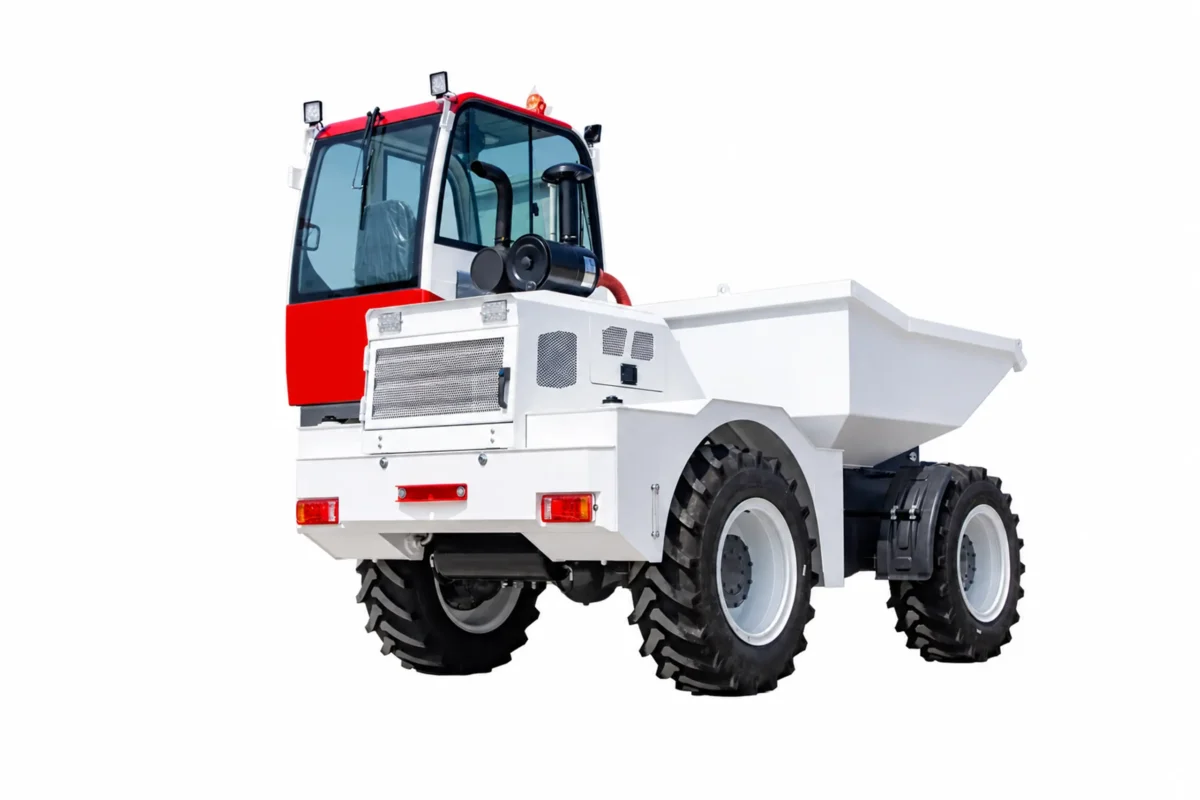
The MG100D lists a 10,000 kg rated load, 3 m³ bucket, 6,500 kg total weight, six 16/70 R22.5 tires and 390 mm minimum ground clearance. It is published at 5,100 by 2,350 by 2,980 mm, with a 4,850 mm turning radius.
This upper route needs loader capacity, stable haul roads, passing and turning space, edge control and a transport plan. It remains a site dumper; do not present it as a public-road or mining haul truck without evidence that the current catalog does not provide.
The U.K. Health and Safety Executive’s dumper guidance advises planning work so dumpers stay within safe gradient capacity confirmed with the manufacturer. It also emphasizes rollover protection, seat-belt use, visibility, even loading, edge control, competent drivers and maintenance. Buyers must apply local rules, but these topics belong in any route review.
Turns can shift stability, especially with a load or raised skip. Design the route to keep turning and tipping on prepared areas. Use wheel stops or edge controls where required by the site design, and maintain clear overhead space.
The article cannot establish the safe gradient for MG20D, MG40D, MG50D, MG60DA or MG100D because a completed value was not visible on the audited pages. Obtain a current model-specific answer and follow the supplied manual.
Water can soften shoulders, hide ruts and reduce traction. Inspect after weather or earthworks change. Repair the route, improve drainage or stop the operation if controls no longer work. Do not rely on four-wheel drive to recover a route that cannot support the loaded machine.
Record defects and take a machine out of service when a safety-critical issue is found, following manufacturer and site procedures. Tires, brakes, steering and skip controls deserve daily attention.
Assign responsibility for grading ruts, maintaining drainage, repairing soft shoulders and keeping turning areas clear. A route that was acceptable during the tender can deteriorate under repeated loaded cycles. Set inspection frequency by weather and use, and record when controls change.
Avoid solving every problem with more stone or a different tire without engineering review. Added material can alter drainage or edge loading. The project should design and maintain the haul road, while the manufacturer confirms the machine’s limits and tire requirements.
At shift change, communicate closed areas and route repairs. An operator who relies on yesterday’s path may enter a newly excavated or weakened section. The route map should be a live site document, not a drawing stored only with procurement.
A hillside drainage job uses a loader at the upper stockpile and tips bedding material at several lower work fronts. The loaded direction descends, while the empty dumper climbs back. A hairpin near the loading point controls model length and turning. Pedestrians move between trenches.
The contractor compares MG20D and MG40D first. Both publish a 4,500 mm minimum turning radius and 250 mm clearance, but widths and payload differ. If the hairpin needs a wider manoeuvre than available, a smaller capacity elsewhere in the range or a route change may be necessary.
At each work front, prepare a stable tipping pad away from trench edges and pedestrian paths. The optional rotating skip may reduce repositioning if included and if its envelope is controlled. Confirm that option in writing.
Estimate the mass of each loader pass from bucket volume, fill and material density. A 4-ton dumper can be overloaded by a small number of dense-material passes. Define the normal count or use an appropriate weighing/control method. Stop loading when the rated and operational limits are reached, not when the skip looks full.
A dealer should use a route questionnaire and, for marginal sites, a survey. Ask material, density, width, turn, gradient, surface, weather, tipping edge, pedestrian controls and transport. Give sales staff the authority to decline a model when the safe gradient or route cannot be confirmed.
The MG40D, MG50D, MG60DA and MG100D use different published tire and axle routes. Identify the installed components before stocking filters, brake items or tires. Ask the supplier to notify component changes on repeat orders.
A showroom or customer demonstration should use a stable, controlled area with competent personnel. Show travel, controls and skip function according to manufacturer guidance. Do not use a steep or soft bank to prove a marketing claim.
Four-wheel drive and a 30 km/h published site speed do not establish permission for public-road travel. Plan appropriate transport between projects using current dimensions, weight and securing information. The MG20D and MG40D differ substantially from MG60DA and MG100D in width and total mass, so a dealer may need different loading arrangements.
Confirm whether the skip, cabin or other items change the transport envelope. List loose items, lifting points and reassembly work. A route decision that is excellent on site can still be commercially poor if the contractor cannot move the machine economically between its typical projects.
The file should contain the material and density range, rated payload, skip volume, current four-wheel-drive configuration, tires, clearance, width, turn, model-specific gradient confirmation, tipping option, route plan, inspection evidence and manuals. The receiver should hold the same information.
The 4×4 site dumper manufacturer supplies a machine envelope. The contractor supplies a controlled route. When those documents agree, MG20D, MG40D, MG50D, MG60DA or MG100D can be selected for a specific short-haul job. When they do not, the responsible action is to change the model or the route before the first loaded trip.
Keep a copy of the route acceptance with the machine, especially in a rental or multi-project fleet. It should identify the site and date rather than becoming a blanket approval. When the dumper moves, the new supervisor repeats measurements and obtains any missing manufacturer confirmation.
The same record helps during incident-free improvement. If operators repeatedly slow at one turn or the road needs frequent repair under the selected payload, treat that observation as design feedback. Adjust passing space, surface maintenance, loading or model choice before adding another dumper to a weak route.
For a dealer, this evidence supports an honest handover: the 4×4 system assists traction within a defined machine and route, while safe gradient, loading, visibility and tipping remain controlled requirements. That explanation is more durable than demonstrating wheel spin in loose soil.
If tight turning is central to the route, resolve the terminology through the articulated-chassis verification guide.
