

Get quote
Get Free Consultation!
We are ready to answer right now! free consultation.
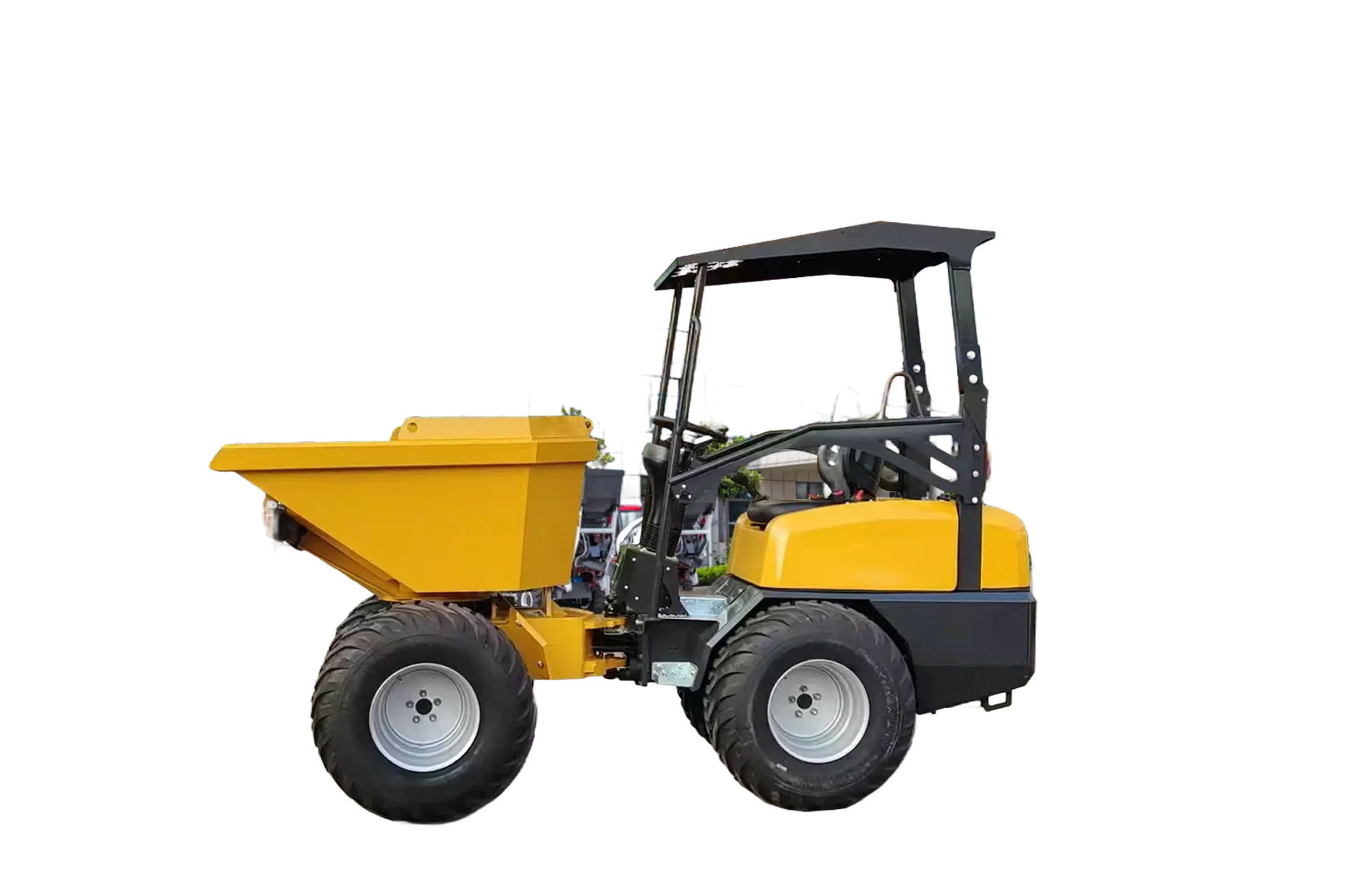
A dumper skip can look half empty and already be at its rated payload, or look full while carrying a light material far below the weight limit. That conflict between mass and volume should lead every site dumper manufacturer conversation. Contractors moving wet soil, broken concrete, gravel, mulch or general spoil need to identify which limit the material reaches first, then check route, visibility and tipping direction.
MEGA publishes eight site-dumper model pages, from the compact MG10D/MG10DB route to the 10,000 kg-rated MG100D. The first confirmation is the normal material and its realistic density range. Then compare rated load, struck or heaped skip volume, drive system, dimensions, turning information and the planned tipping point. Buyers can start with the site dumper range and discard models that fail either mass, volume or route.
The right dumper does not eliminate traffic or tipping hazards. The project must separate people and vehicles, control edges and slopes, and use trained, competent operators under local requirements. The manufacturer must provide current limits and instructions for the supplied machine.
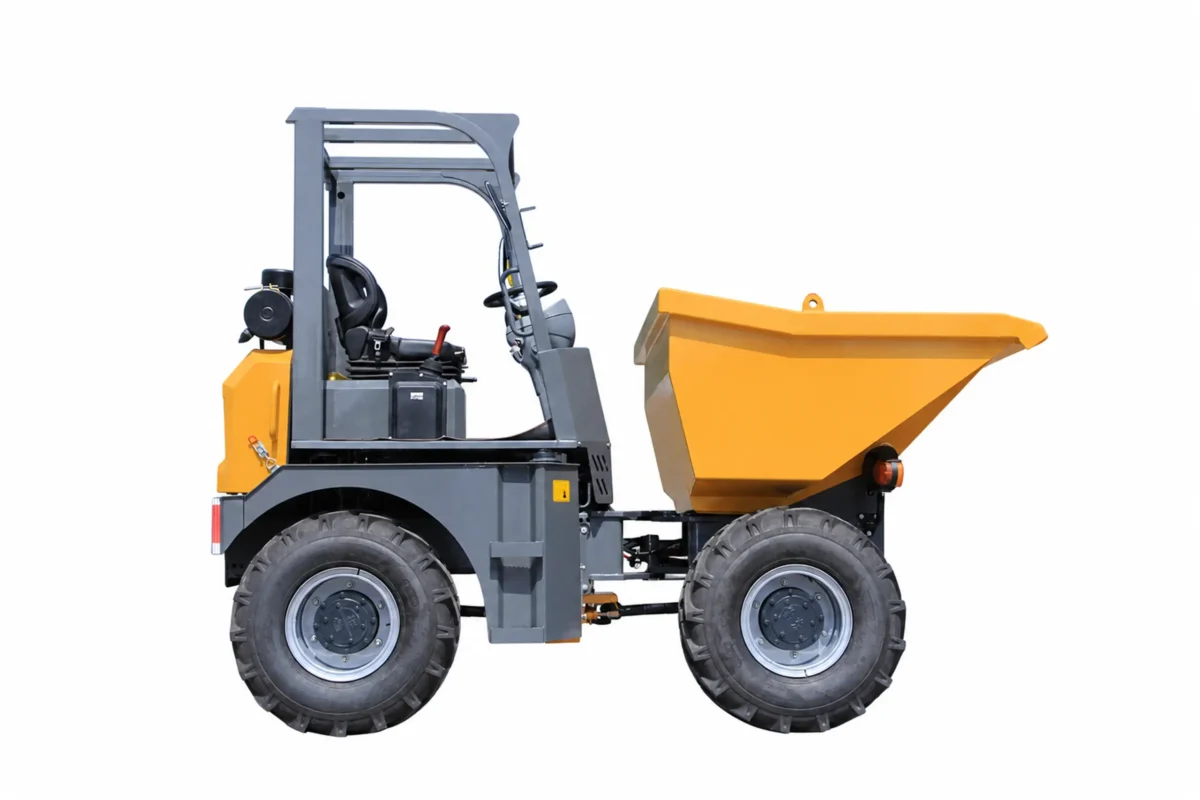
Rated payload is a mass limit. Skip capacity is a volume. Material density connects them. A one-cubic-metre skip full of a dense material can weigh much more than the same skip full of dry mulch or light waste. Moisture and particle size also change the result.
Estimate payload by multiplying loose material density by actual loaded volume, then apply the project’s conservative control and the manufacturer’s instructions. Do not fill above the skip edge or rely on appearance. Where the source material varies, use the densest realistic condition for selection and operating controls.
The MG10D publishes a 1,300 kg rated load and 1,500 kg maximum load. It lists 0.5 m³ struck capacity and 0.65 m³ heaped capacity. Normal operation should be planned around the manufacturer’s rated limit and instructions, not the largest number in the table.
The same page publishes a plus-or-minus 90-degree skip rotation, 12 km/h maximum travel speed, 242 mm minimum ground clearance and 1,046 mm overall wheel width. Those details make it a compact swivel-skip route for controlled short haul, not a universal substitute for larger dumpers.
The MG20D lists a 2,000 kg rated load and 1 m³ bucket. The MG30D lists 3,000 kg and 1.6 m³. Both publish four-wheel drive, 250 mm minimum ground clearance and a 4,500 mm minimum turning radius.
A buyer moving a material near two tonnes per cubic metre could reach roughly two tonnes in a full one-cubic-metre skip before accounting for variation and operating controls. The 1.6 m³ skip on the MG30D does not mean every material should fill it to the rim. Ask the supplier to discuss the expected material and define safe loading practice.
The unloading area often decides more than the haul distance. Identify whether the dumper tips forward, rotates the skip, or offers an optional rotating route. Measure edge distance, receiving width, overhead hazards and the stable position of the machine. Keep people away from the tipping zone and preserve the operator’s view.
The U.K. Health and Safety Executive’s dumper guidance highlights overturning, collisions, gradients, edge protection, visibility, loading and competent operation. Buyers worldwide must follow their own rules, but these risk categories are useful when building a procurement and site plan.
| Tipping question | Published MEGA evidence | Buyer action |
|---|---|---|
| Can the skip direct material sideways? | MG10D lists ±90° rotation; larger pages list an optional rotating bucket | Confirm exact supplied mechanism and operating envelope |
| How close can the machine approach? | MG10D publishes front and side safe dumping clearances | Compare the current drawing with the receiving edge |
| Does the load block vision? | Skip size and material profile affect view | Keep load controlled and plan traffic separation |
| Is the ground stable while raised? | Weight, tires and clearance are model-specific | Prepare a level tipping zone and follow limits |
| Can the dumper leave without a hazardous turn? | Dimensions and minimum turning radius guide the route | Survey entry, tip and exit as one movement |
The MG10D page publishes 480 mm front safe dumping clearance and 398 mm side safe dumping clearance, along with a 70-degree dumping angle and 2,530 mm maximum dumping height. These numbers should be confirmed against the current supplied configuration and a drawing before the project designs a receiving edge around them.
A rotating skip can help discharge to the side on narrow work fronts, but the rotating mass needs clear space. Mark the envelope and prevent people from entering it. Do not confuse skip rotation with articulated chassis steering; they are different functions.
The MG50D page lists a 5,000 kg rated load and 2.5 m³ bucket. The MG100D lists 10,000 kg and 3 m³. A heavier machine approaching an excavation edge creates different ground and stopping concerns. The project should set a safe tipping position with appropriate edge controls and verify ground support.
HSE’s separate tipping guidance notes the need for suitable tipping areas and overhead clearance. It is general external guidance, not a model instruction. The MEGA manual and current manufacturer confirmation govern the supplied machine.
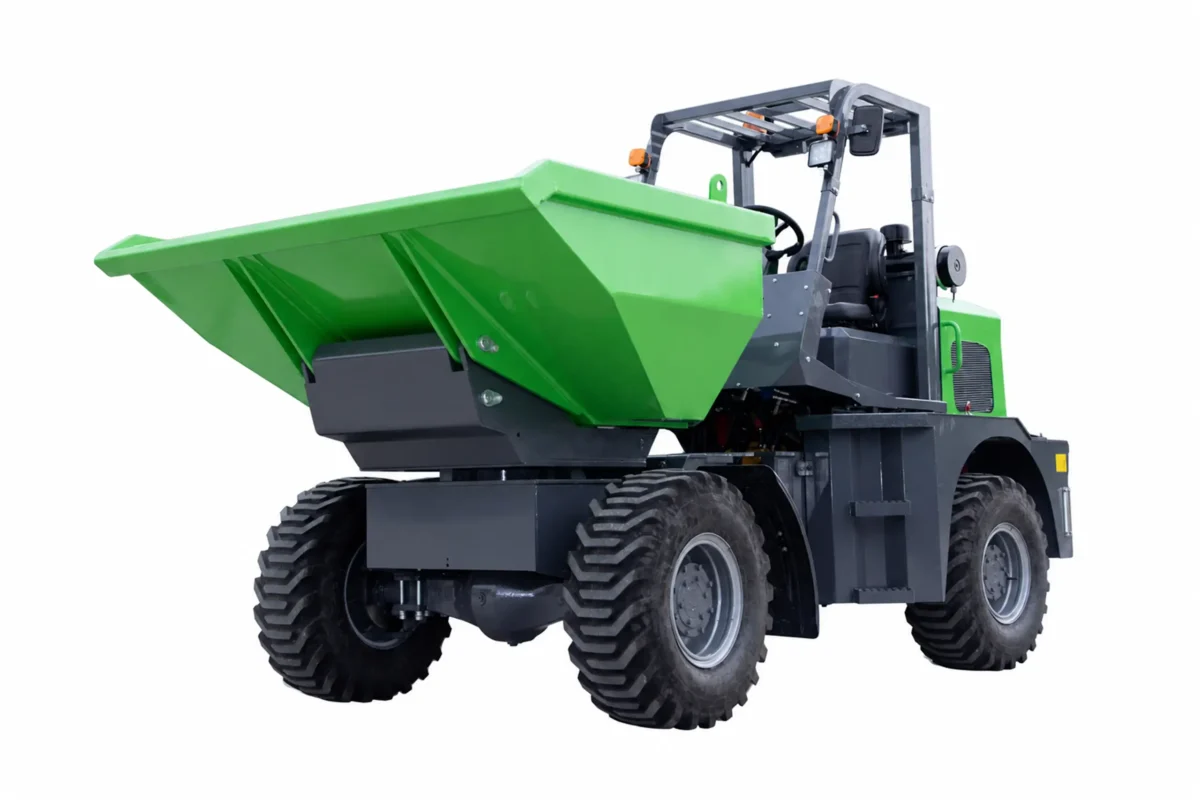
Map the loader, loaded path, passing points, gradients, pedestrian routes, tipping area and empty return. A short distance can still be difficult if the path is narrow, soft, blind or steep. Four-wheel drive improves a machine’s drive arrangement; it does not set a safe route by itself.
MG20D through MG40D publish a 4,500 mm minimum turning radius, while MG50D, MG60DA and MG100D list 4,850 mm. Overall width rises from 1,630 mm on the MG20D to 2,350 mm on the MG100D. Add clearance and the actual machine’s steering path.
A contractor may find that a higher-capacity dumper reduces cycles but cannot turn beside the loader without reversing. Compare the lost manoeuvring time and traffic risk with the smaller model’s extra cycles. The best payload is the one the route can use.
The MG20D and MG30D publish 250 mm minimum ground clearance and 20.5/70-16 tires. The MG50D lists 270 mm and 16/70-20. The MG60DA lists 320 mm with the same nominal tire size, and the MG100D lists 390 mm with a six-tire 16/70 R22.5 configuration.
These figures help compare geometry and running gear, but tire pressure, ground bearing and safe slope need current manufacturer guidance. Record drainage, ruts, soft shoulders and weather changes. If the route deteriorates, stop and reassess rather than treating 4×4 as permission to continue.
A demolition contractor may load broken masonry at one end of a building plot and tip into a controlled receiving area. Dense fragments can reach payload before a large skip is visibly full. The route may pass workers and scaffolding, and the tip area may be near an excavation.
The buyer could compare MG10D, MG20D and MG30D rather than jumping directly to the largest dumper. Confirm the densest expected material, loader bucket, required cycles and narrowest point. If the MG30D saves cycles but blocks the route, the smaller machine may produce a safer, more predictable flow.
Count loader passes and estimate mass per pass. A loader operator should not guess the dumper’s payload from bucket appearance. Where practical, use a documented loading method and appropriate weighing or control process defined by the project and manufacturer.
If the loader bucket can overload the skip in one or two passes, the pairing needs especially clear controls. If it requires many small passes, cycle efficiency may suffer. The supplier can provide machine limits; the project defines the loading method.
Keep a short material register for variable spoil. Separate clean soil, wet clay, rock, mixed demolition material and light waste rather than applying one density. If the loader moves from one pile to another, the normal pass count may need to change. A supervisor should be able to explain the approved loading basis to both loader and dumper operators.
Cycle calculations should also include waiting at the tipping point. A large dumper can save loaded trips but create a queue if only one machine can enter a narrow receiving area. Observe the complete system: loader wait, loaded travel, tip, return and any traffic hold. Sometimes improving the tipping pad produces more output than buying additional payload.
On arrival, compare the skip and loader pairing against the ordered configuration. A changed bucket or rotating mechanism can alter the original loading plan. Preserve the decision in the machine record so a later operator knows why a certain material or pass count was chosen.
Several MEGA pages describe plus-or-minus 90-degree tipping as optional. The purchase order should state whether the rotating skip is included. Inspection evidence should show the exact supplied function, and the packing or handoff file should identify any loose components.
A photograph of another model with a rotating skip is not confirmation. Tie evidence to the model plate or order reference.
A dealer serving landscapers, utility crews and building contractors might choose three roles: compact swivel-skip, mid-payload 4×4, and higher-capacity open-site haul. The MG10DB is described as a compact swivel-skip dumper with the same 1,300 kg rated and 1,500 kg maximum load structure as the MG10D. The MG30D can form a middle route, while MG60DA or MG100D addresses a different customer and logistics class.
Sales staff should ask material, density, route width, turning, slope and tipping direction before offering the stock unit. A dealer that only asks desired tonnage risks selling excess skip volume, insufficient payload or a machine that cannot manoeuvre.
Keep engine, axle, tire, filter and brake information by exact model. Build operator familiarization and delivery checks around the supplied controls and skip mechanism. Do not assume a driver trained on one dumper can operate every configuration without assessment.
The dealer should also explain that payload and skip volume are independent. That single lesson can prevent customers from treating a full-looking skip as the only overload indicator.
The final selection should survive a desk calculation and a site walk. Confirm normal material, density range, rated load, skip capacity, loader pairing, route, width, turn, ground, slope, visibility, tipping direction and edge controls. Obtain current dimensions and the exact skip option from the manufacturer.
Before shipment, ask for model-linked checks of travel, steering, braking, skip lift and rotation where supplied. On arrival, inspect transit condition and reconcile loose items before commissioning under the manufacturer’s instructions. Daily checks and maintenance should follow the supplied documentation and site risk controls.
A site dumper manufacturer is not being asked merely for a larger skip. It is being asked to connect material mass, usable volume, vehicle movement and tipping geometry. When those four agree, the MG10D, MG20D, MG30D, MG50D or MG100D becomes a defensible choice for a real haul route.
Dealers applying these payload boundaries across stock can use the site-dumper range-planning guide.
