

Get quote
Get Free Consultation!
We are ready to answer right now! free consultation.
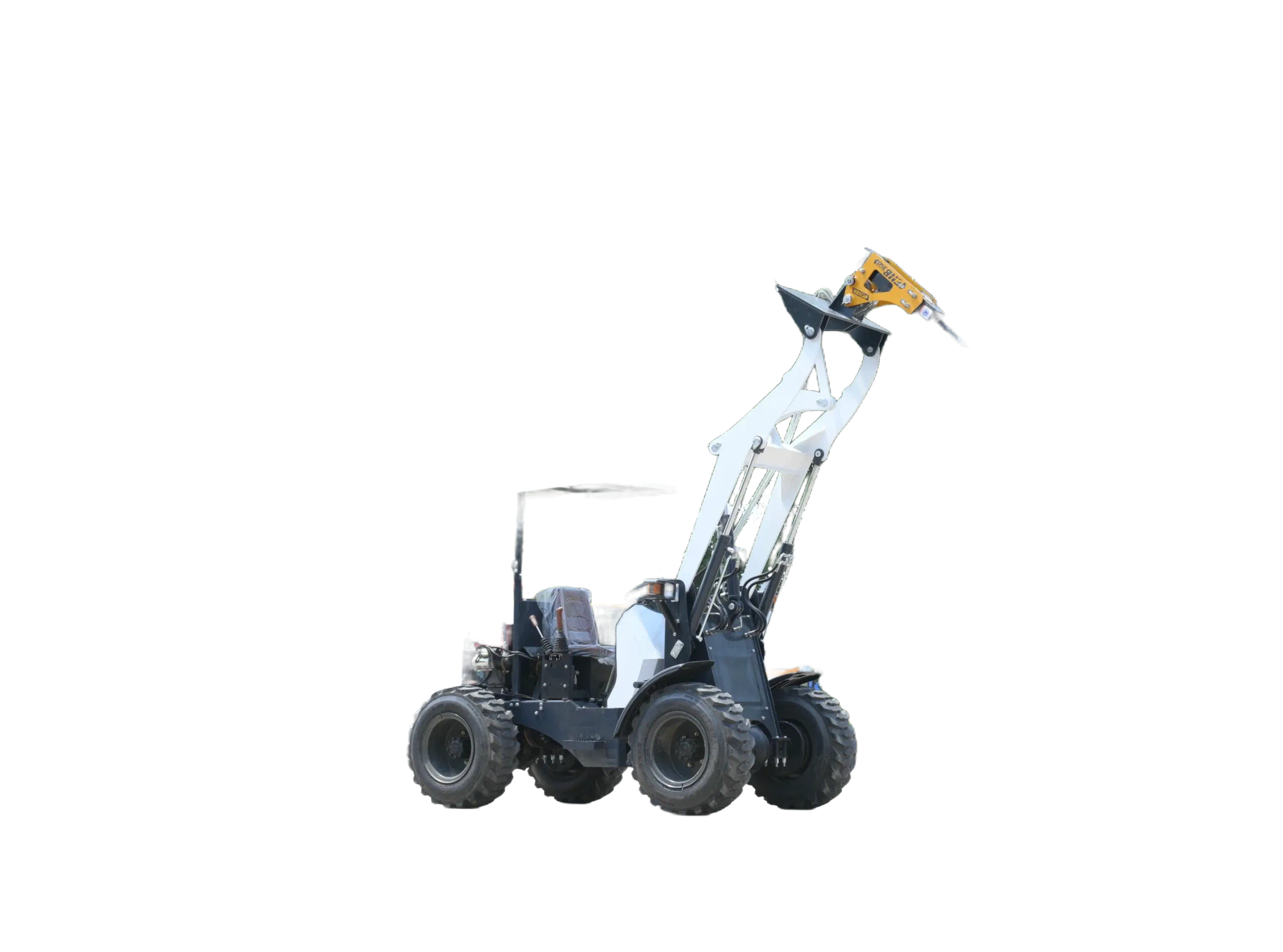
A compact loader can fit the catalogue category and still fail at the first doorway. The buyer needs a measured path from entry gate to stockpile and then to the receiving bin: width, roof height, turn, floor strength, grade, bucket swing and dump edge. Only after that sketch exists should a compact wheel loader manufacturer recommend payload or attachments.
MEGA publishes the 800 kg MG910C, 1-ton MG910 and MG910H, compact EC430 telescopic loader and electric EV910. They solve different constraints. A farm with a 1.4 m gateway and low shed roof may begin with the MG910C. An urban renovation team trying to clear a high skip may need more dump geometry than the smallest machine provides. Neither buyer should sacrifice safe capacity simply to make the loader fit.
Draw the route at scale. Mark the narrowest permanent opening, any posts that reduce the turn, roof beams, ramps, people, fragile floors and the height of every receiver. Add at least the installed bucket width and the machine’s swept path. A brochure’s overall width does not automatically include every attachment projection.
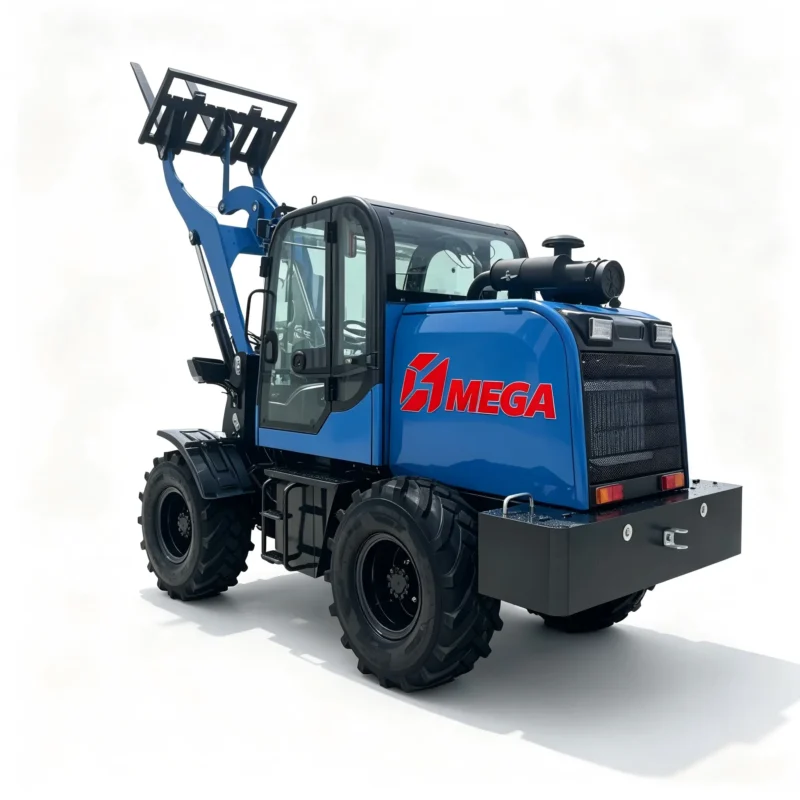
For a 1.4 m gate, a published 1,300 mm machine width leaves only 50 mm on either side before mirrors, bucket edges, tire variation, posts or steering angle are considered. That is not a comfortable operating allowance by itself. Measure the opening at several heights, and identify whether the loader must enter straight or turn while passing through.
MG910C lists overall dimensions of 4,180 x 1,300 x 1,980 mm, a 1,300 mm bucket width, 250 mm ground clearance and 3,200 mm minimum turning radius. Its rated load is 800 kg, operating weight 1,500 kg and bucket range 0.3-0.5 m³. It uses 4×4 drive and a manual mechanical 2F/2R gearbox.
A farm buyer can overlay those dimensions on a yard sketch. If the 1,980 mm height is below the shed opening, add clearance for floor variation, tire condition and movement. The 2,400 mm dumping height and 802 mm reach must then be compared with the feed bin, not assumed adequate because the machine entered the building.
MG910C is less suitable when the normal bucket of damp aggregate approaches or exceeds the 800 kg rating. A compact footprint does not excuse repeated overload. Reduce bucket volume, change material handling, or move to a larger class after checking that it can still use the route.
The MG910 raises the published load to 1,000 kg and uses a 0.4 m³ bucket. Its overall size is 3,300 x 1,500 x 2,350 mm, with 2,300 mm dumping height and 750 mm reach. The 45 kW engine, articulated chassis and 4×4 drive create a different operating route from MG910C.
This machine cannot pass the same 1.4 m gate on the published 1,500 mm width. It may serve another part of the property or a buyer with wider access. The shorter overall length does not rescue the width or roof conflict. A compact wheel loader manufacturer should show these trade-offs rather than simply proposing the higher rating.
MG910H publishes the same 1-ton source specification on its page. A buyer comparing MG910 and MG910H should ask the supplier to state the actual difference, if any, in the offered configuration. Do not create an unsupported distinction from the model suffix.
Turning radius is not a complete swept-path drawing. An articulated loader bends at the centre, so the bucket and rear can follow different arcs. Walls, stacked goods and pedestrians may sit outside the nominal tire path but inside the machine envelope.
Draw the loader entering straight, fully committed to the turn and exiting. Add the bucket at ground-carry height and at any raised position the site requires. Verify the rear swing and sight line. Where a turn sits beside a doorway, leave room to correct alignment without repeatedly steering against the structure.
An urban renovation crew may have a tight entrance followed by an open courtyard. MG910C could pass the gate, yet its listed 2,400 mm dumping height may not clear the selected skip. Moving to MG910 would reduce height further to 2,300 mm while increasing width. The buyer may need a different receiving container, ramp arrangement or loader family rather than choosing between those two on payload.
MG910C lists 1,500 kg operating weight before its carried load; MG910 lists 2,100 kg. Check slab capacity, basement covers, ramps and soft edges with the responsible project engineer. The published MG910C maximum gradeability is 30%, but a buyer should not use a maximum figure as a routine loaded-route promise. Surface, slope direction, turning and carried load all matter.
Keep loads low during travel under approved operating instructions. Low roofs can tempt operators to carry in an unusual position, so the route should be checked with the bucket in the safe travel attitude and with the receiver approach separately.
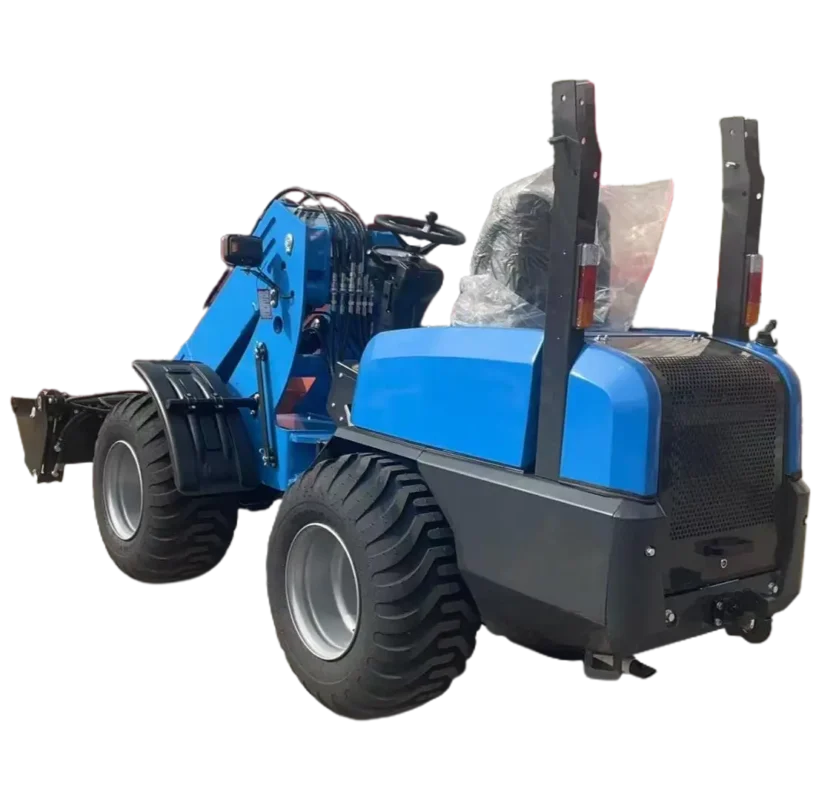
The EC430 telescopic loader publishes 1,046 mm total wheel width, 4,430 mm body length, 1,800 kg body weight and 45-degree articulated turning. It lists an 800 kg main-arm load and 450 kg with the small arm extended. Maximum unloading height rises from 2,215 mm before extension to 2,825 mm after extension, with a 1,350 mm safe unloading distance after extension.
A buyer with a narrow route and higher bin can explore EC430 because its telescopic geometry addresses reach rather than simply increasing machine class. The trade-off is explicit: published load falls from 800 kg on the main arm to 450 kg with the small arm extended. The material and attachment must stay within the approved load at the actual extension.
This route is inappropriate if the customer assumes 800 kg remains available at full reach. Ask for the manufacturer’s load information for the ordered attachment and boom position. Uneven ground, articulation and side reach also need site controls.
If MG910C clears the bin and carries the normal material, telescopic reach may add complexity without solving a real constraint. Compare service capability, controls, attachments and operator needs. The narrowest machine is not automatically the most productive, and the longest reach is not automatically the safest.
The Yanmar V100 product material demonstrates how compact-loader manufacturers publish dimensions and working geometry together. Its numbers describe Yanmar equipment, not MEGA. Use the categories of information to ask better questions without importing another machine’s capacities.
The bucket may be wider than the tires, and a fork carriage or grapple may project beyond the base machine. Add the exact attachment to the turning drawing. A loader that fits straight through a gate can strike a post when the articulation joint begins to turn.
MG910C publishes a 1,300 mm bucket width matching its listed overall width. MG910 publishes a 1,400 mm bucket width while the machine is 1,500 mm wide. Verify the delivered bucket because an optional width changes the clearance. Measure cutting edges, side plates and any quick coupler that affects forward projection.
Where the route passes pedestrians or stored goods, establish separation and a controlled travel direction. A compact turning envelope should not be treated as permission to work in unsegregated space.
If a buyer requests pallet forks, obtain manufacturer capacity information for the carriage, fork length and actual load centre. Long loads may extend through a doorway while the machine remains inside it. Mark the pallet corners on the sketch and identify whether the load can be approached squarely.
Where pallet work dominates, compare the all-terrain forklift range rather than forcing the loader to become a mast truck. The correct machine should fit the site and the handling method.
The EV910 publishes a 400 kg maximum load, 0.25 m³ bucket and overall dimensions of 2,100 x 1,100 x 2,090 mm. It lists 1,800 mm dumping height, 200 mm ground clearance, a 12.0 kWh lithium iron phosphate battery, 10-hour working time and 6.5-hour charge time.
Its 1,100 mm width is attractive for narrow access, while electric drive can suit sites that value lower local exhaust and reduced operating noise. The buyer must still review ventilation, charging location, electrical supply, battery care and actual duty. A published working time needs confirmation against load, travel, hydraulic use, temperature and battery condition.
EV910 should not be proposed for a high skip merely because it fits indoors; its listed dumping height is 1,800 mm. Nor should its 400 kg capacity be stretched to replace MG910C. A smaller, clean-running machine only works when the load and receiver also fit.
Mark the parking position, cable route, electrical protection and time available between shifts. Keep charging away from vehicle conflict and follow supplier and local electrical instructions. Confirm the supplied charger, connector, input requirement and expected charging conditions before shipment.
The final order should attach the measured gate, lowest roof, tightest turn and highest receiver. It should state the normal material, bucket, maximum approved load for the task, tire and cabin configuration. Request a current drawing because accessories and design changes can alter the envelope.
At factory inspection, show the model identity, measure critical width and height, identify the bucket and operate steering, brakes, boom, rollback and discharge under the manufacturer’s safe procedure. For EC430, demonstrate the ordered attachment at relevant boom positions without implying unverified capacity. For EV910, record battery and charger identity.
On arrival, repeat the critical measurements before entering the restricted route. A compact loader that misses a doorway by 20 mm is not a small error; it is the wrong configuration for that path. The best selection leaves deliberate clearance, carries the normal material within its approved limit and reaches the receiver without improvisation.
For repeat orders, attach photographs of the first machine at the gate, turn and receiver, together with the approved dimensions. Ask the manufacturer to disclose changes in tires, cabin, counterweight, bucket or coupler. A model name can remain constant while the centimetres that made the first route successful change.
The site sketch should stay in the operator briefing rather than disappearing into the purchasing folder. Mark no-go corners, the safe loading direction and the bucket position used under the roof. If stored material narrows the lane or a new bin changes the turn, stop and redraw the route. Compact dimensions help only while the workplace preserves the clearances on which the selection depended.
Post the measured clearance at the entrance and prohibit unapproved buckets or tire changes. A new attachment can invalidate the drawing even when the loader itself is unchanged. Recheck after floor repairs, resurfacing or roof work.
Sites considering battery power after the dimensional check should build the electric-loader shift and charging plan.
