

Get quote
Get Free Consultation!
We are ready to answer right now! free consultation.
A pallet can weigh exactly 3,500 kg and still fall outside a 3.5-ton forklift’s approved capacity when it is long, off-centre or carried on an attachment. The first question for a rough terrain forklift manufacturer is therefore not “How many tons?” It is “What is the load centre and how is the load secured?”
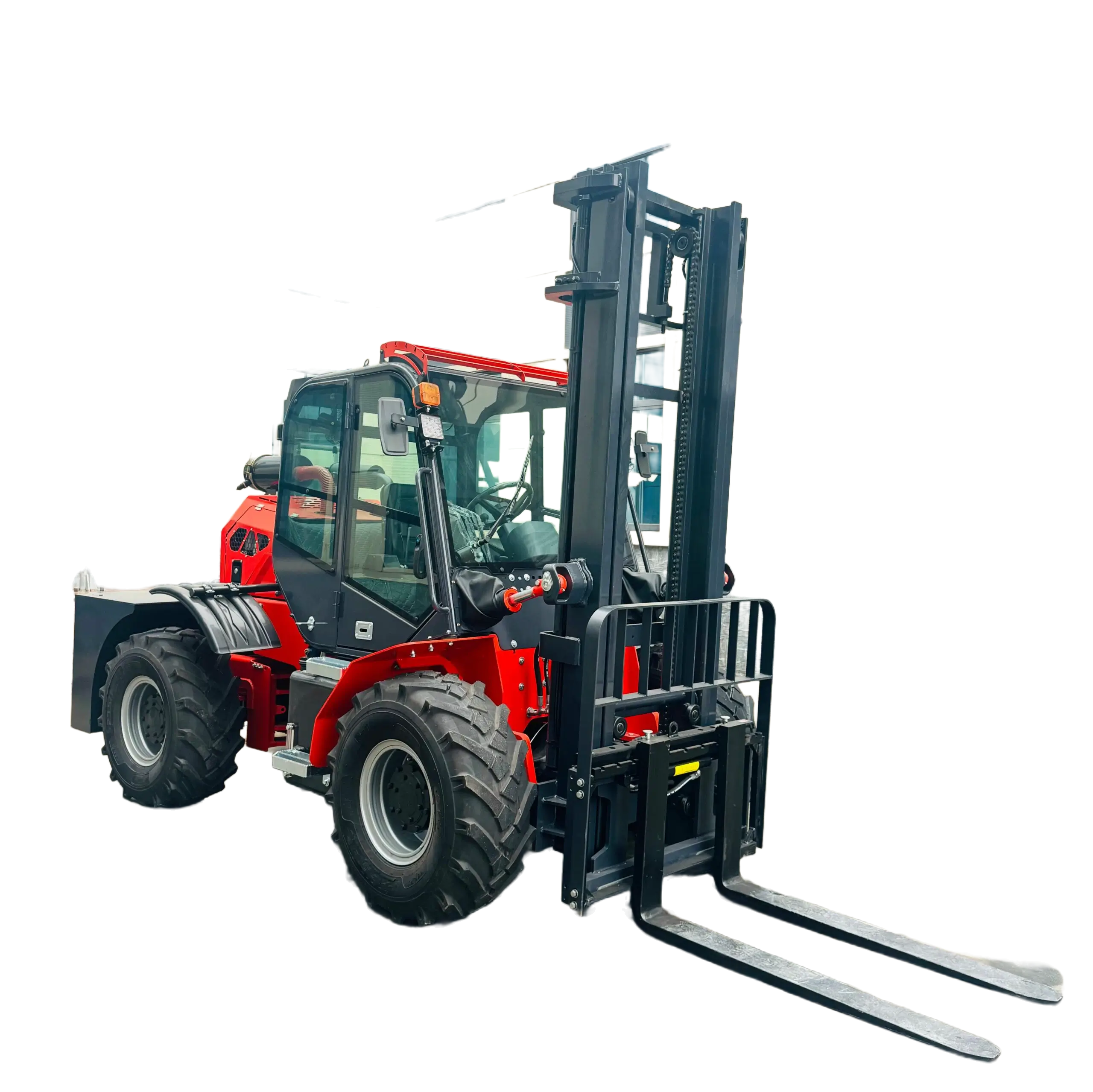
MEGA publishes five 3.5-ton all-terrain forklifts: MG3501, MG3550, MG3580, MG3581 and MG3582. The pages list 4×4 or all-terrain configurations, 36.8 kW engines, multi-stage mast options and outdoor tires, but the models differ in weight, dimensions, transmission and steering data. Begin with the all-terrain forklift range only after the pallet drawing and route are known.
A construction buyer may have a 3,500 kg load whose centre lies beyond the MG3501’s published 500 mm load-centre distance. A farm may need traction across disturbed ground but still must travel with the load low and stable. Four-wheel drive helps movement; it does not cancel the physics of the load moment.
Provide load weight, length, width, height, centre of gravity, fork-entry direction, packaging and whether contents can shift. Mark the horizontal distance from the fork face to the load’s centre. Include the fork or attachment mass and thickness. A simple pallet photo cannot establish these facts.
The MG3501 publishes a 3,500 kg rated load and 500 mm load-centre distance. If a uniformly distributed load is longer in the fork direction, its centre may sit farther than 500 mm from the fork face. The resulting moment increases even when total mass stays at 3,500 kg.
Ask MEGA for capacity information at the actual load centre and selected mast height. If the approved capacity is lower, reduce the load, change handling direction, use suitable handling equipment or choose another machine. Never infer a derating formula from a general explanation.
The load should also be stable. OSHA’s load handling guidance and load composition guidance explain principles such as knowing load weight, stability and capacity. Site rules and the manufacturer’s instructions govern the actual operation.
MG3501 lists optional buckets, clamps, forks and boom tools. An attachment adds its own mass and can move the load forward. The rough terrain forklift manufacturer should approve the exact attachment and provide revised capacity information or data plate treatment where applicable.
A dealer should not quote a clamp as a harmless accessory. The purchase order should identify attachment model, mass, centre of gravity, mounting, hydraulic requirement and approved load. Factory evidence should show that specific system.
MG3501 lists a 3,000-6,000 mm lifting-height range and a 2,250-2,930 mm gantry-height range. A higher or multi-stage mast can affect collapsed height, free lift, visibility, stability and capacity. The buyer needs one selected mast, not a range.
A contractor may need 4,500 mm lift outdoors and then enter a warehouse door. Measure both the required placement height and the door. The selected mast’s collapsed height, overhead guard and any load projection must clear with safe margin. Do not assume the lowest gantry number applies to the tallest lift option.
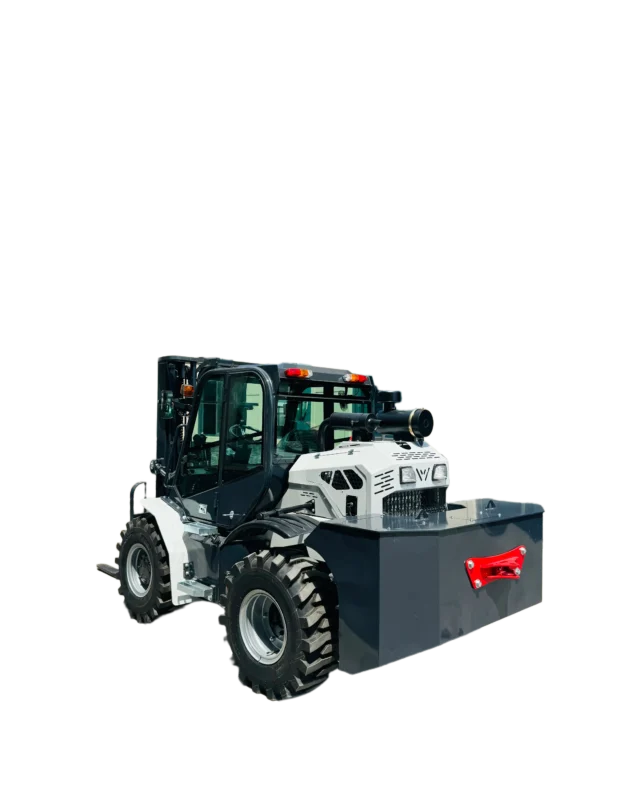
The MG3550 lists a custom multi-stage mast, 3,400 x 1,800 x 2,250 mm overall dimensions and 1.22 m standard forks. Ask for the exact collapsed and extended mast drawing, fork section and capacity at height.
At factory acceptance, do not ask for an improvised maximum test. Agree a safe procedure based on manufacturer limits and applicable regulations. Verify mast operation, tilt, chains, forks, hydraulics and warning devices with an approved representative load. Record the load, centre and height shown.
Rough terrain creates ruts, soft shoulders, cross slopes and sudden steering corrections. Four-wheel drive can improve the ability to move, but stability depends on load position, speed, turn, grade, tire condition and ground.
A construction forklift may cross compacted fill from delivery point to storage. Survey the route, repair potholes, set traffic separation and identify cross slopes. Follow the manufacturer-approved travel position and speed. Do not travel with a raised load to improve visibility or clear obstacles.
MG3501 publishes 300 mm wheelbase ground clearance, 240 mm gantry clearance, 23.5/70-16 tires and maximum gradeability of no more than 25 degrees. That maximum figure should not become a normal loaded-route target. Request approved loaded grade and operating limitations for the selected machine.
If the route turns across a slope, redesign it where possible. Loading and unloading should occur on a firm, level area. A timber yard that requires a sharp turn on an incline should not rely on 4×4 traction to offset an elevated or long load.
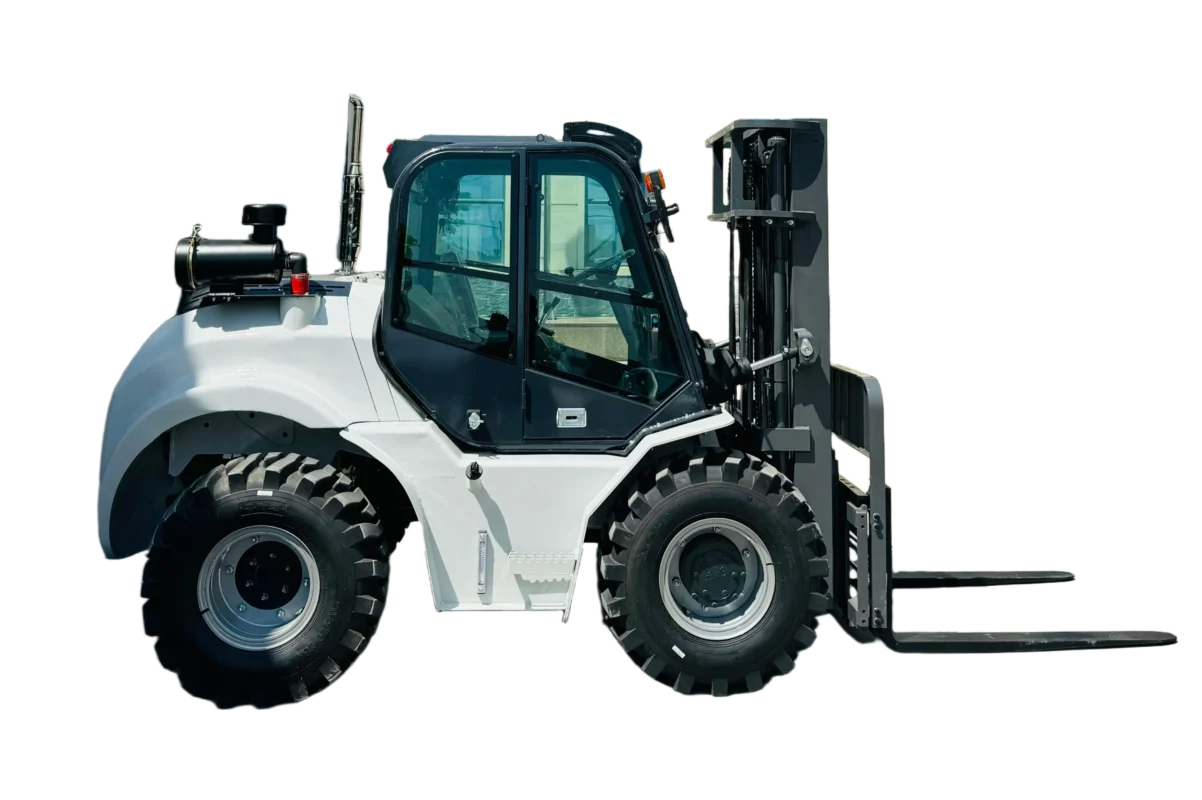
MG3581 lists a central differential with switchable floating axle/full-time 4WD, 20.5/70-16 tires and 230 mm ground clearance. These are traction and clearance facts. They do not prove suitability for every slope.
All five models publish a 3,500 kg class and 36.8 kW engine route. Some values repeat; others differ. The buyer should identify what is confirmed, what is an option and what needs correction.
MG3550 lists full-hydraulic 4F/4R transmission, 4,700 kg operating weight, 3,400 mm overall length and mixed front/rear tire sizes. MG3580 lists 4×4 drive with mid-speed selection, 5,300 kg operating weight, 3,200 mm overall length and 20.5-16 tires front and rear.
Those entries should be copied into a controlled comparison and confirmed. They may affect service, transport and route selection. A lighter or shorter number is not automatically better without understanding configuration and stability.
MG3581 and MG3582 publish an 80-degree steering angle and 500 mm minimum turning radius. That radius is unusually small for machines around 3,400 x 1,800 mm, while MG3501 and MG3550 list 2,200 mm. Do not plan a yard from the 500 mm value until the supplier provides a current drawing and demonstrates the measured turning envelope.
This is not a reason to reject the machines automatically. It is a reason to keep the field open in the audit. A professional supplier should be able to confirm, correct or explain a surprising value.
Send a short operating profile with the load drawing: pickup height, travel distance, maximum grade, surface, turning point, placement height and doorway. The manufacturer can then respond to one real duty instead of a collection of unrelated maximums.
Concrete blocks may be uniform in mass but carried in long packs. State whether the forks enter from the long or short side, the pallet depth, wrapping and centre of gravity. The shorter travel distance does not reduce the load moment. If packs are damaged or unstable, correct the packaging before lifting rather than relying on mast tilt to hold them.
At the placement stack, record the required top height and available aisle. A custom mast may reach it, but the supplier must confirm capacity and collapsed height. The yard should provide a level loading lane instead of testing the machine on loose block debris.
Timber packs can have uneven density, long projection and surfaces that allow pieces to shift. Identify banding, fork spacing and whether a clamp or other approved attachment is needed. The attachment’s weight and forward offset belong in the capacity response.
A 4×4 forklift may cross compacted gravel between stacks, but the route should avoid side slope and sharp turning with the pack raised. The operator needs a clear set-down area if the load becomes unstable.
Unloading a truck on a prepared pad is different from carrying pallets across recently backfilled ground. Mark the handover point, inspect the travel lane and keep lifting away from unsupported edges. Where ground cannot be prepared, reconsider the handling method rather than treating ground clearance as permission.
The rough terrain forklift manufacturer should identify any limitation for the selected tires, mast and load on the route. A site supervisor then controls daily changes such as rain, ruts and temporary obstructions.
The machine can only retain its approved capability when forks, mast, tires, brakes, steering and hydraulics remain serviceable. Use the manufacturer’s manual and local rules to develop checks for the delivered configuration.
MG3501 lists 23.5/70-16 tires, while MG3550 publishes 20.5-16 front and 12-16.5 rear. MG3581 uses 20.5/70-16 front and rear. Confirm the ordered tire markings, pressure or maintenance route, condition and any effect on dimensions. Do not swap a tire merely because it fits the rim.
Verify fork identity, locking, visible damage, chain condition and mast operation under approved inspection procedures. Keep fork spacing suitable for the pallet and load. If an attachment is fitted, confirm hydraulic connections and capacity information remain present.
For MG3581 or MG3582, measure the actual swept path on a level open area rather than relying on the 500 mm listed radius. Mark outer load and rear paths. The resulting drawing can then be used for the yard layout and operator briefing.
The order should name rated capacity at the specified load centre, mast type and height, collapsed height, fork length, attachment, tire, engine, emission route, transmission, axle, brakes, cabin or overhead guard and destination requirements. Add the load drawing and route sketch.
Photograph the model plate, engine, mast, fork markings, tires, attachment and data plate. Measure critical overall and mast heights. Demonstrate steering and braking under the manufacturer’s procedure, then a safe lift with an approved load whose weight and centre are known.
Inspect shipping condition, mast, forks, chains, hoses, tires and loose attachments. Confirm documents and identity. Train operators for the actual route, attachment and load, and keep the approved capacity information where it can be consulted.
A buyer should reject two shortcuts: treating 3.5 tons as capacity at every load centre, and treating 4×4 as stability on every surface. The correct MG3501, MG3550, MG3580, MG3581 or MG3582 configuration is the one the manufacturer can support at the real pallet geometry, mast height and prepared route.
Keep a scale or verified shipping document available for loads whose mass changes. Mark standard pallet weights and approved fork entry in the warehouse system. When a supplier changes packaging length or centre of gravity, treat the pallet as a new load rather than relying on its old product name. That small discipline protects the capacity decision long after commissioning.
Supervisors should also record rejected loads and the reason, so later shifts do not attempt the same unapproved lift.
Once the load geometry is approved, select the yard route through the all-terrain forklift outdoor-site comparison.
